
It is now officially warm, we are using our awnings, and even running the air conditioning on occasion. All of which brings to mind the subject of air con capacity. If you are going to have a air conditioning, and it is very nice in some situations, it needs to be looked at in an overall systems context. Typically the major power consumer aboard, if designed without thought for overall efficiency, the penalties can be substantial. The industry norm is to maximize capacity, for the worst possible situation, and then run the air on a low duty cycle. This forces you into big generators because of starting and running loads, which are loafing (bad) when the air is not running.
We think there is a better way.
To begin with, if you are cruising with the seasons, tropics in winter, temperate climate in summer, capacity can be substantially reduced. Awnings are another potentially huge saver. On Wind Horse as it gets warmer we use both house window and deck awnings. These reduce power consumption by a third to a half depending o sun angle.
Then there is the logic of how the system is used. We are designed to ventilate when headed into the wind. At anchor, with five knots of breeze, we have such a nice flow of a air through the boat that we don’t need air conditioning. But tied to the dock, when the breeze drops, or when it is buggy and we need to close hatches, we love the comfort of the air conditioners (going soft in old age).
Here are a couple of surprising statistics. The night before last the bugs were out so we were forced to close up. We started the genset, with the interior at 84F/28C. Forty five minutes later we were12 degrees F / 6.5C cooler. We shut down the genset and were fine for the night.
Heat loads are higher in the day of course, with the sun beating down on us. We’ve been checking out the metropolis of Vigo. Upon return to a closed up boat at the marina the interior was 94F / 34C. Shore power is limited to 16 amps at 230VAC so we are running three of our four air conditioning units. One hour later the temperature has dropped 10F/6C.
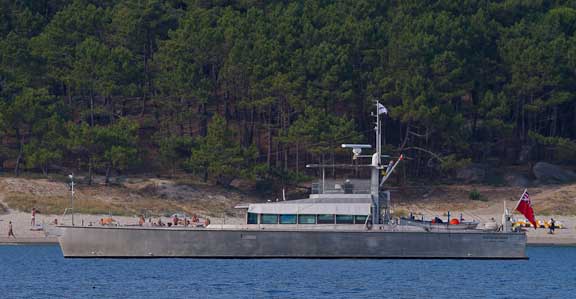
Wind Horse has a lot of glass which is a heat negative, even with the awnings. She also has nine uncovered deck hatches which shine on the interior. Yet we are using just two sixteen thousand BTU units for the salon, a twelve for the forward stateroom, and a ten for the aft end. At sea we can run these units with our inverters, batteries being replenished with the engine mounted alternators. And the genset, after five years of cruising (mostly at anchor), is now at just 630 hours.
Where this approach would make less sense is in a really hot and humid environment. Think Florida or the Gulf States (US or Middle East) in summer. If much time is going t o be spent there, then more air capacity, and bigger generators, will be required.
Posted by Steve Dashew (June 29, 2010)
