
A Conversation with Steve Dashew
– BuzzSprout
– Spotify
– Apple
– YouTube
– iHeart (US Only)
“When you start attracting the attention of the professionals in a country like New Zealand, you know you’re onto something.”
Some boats are built to answer a question.
Others end up creating an entirely new category.
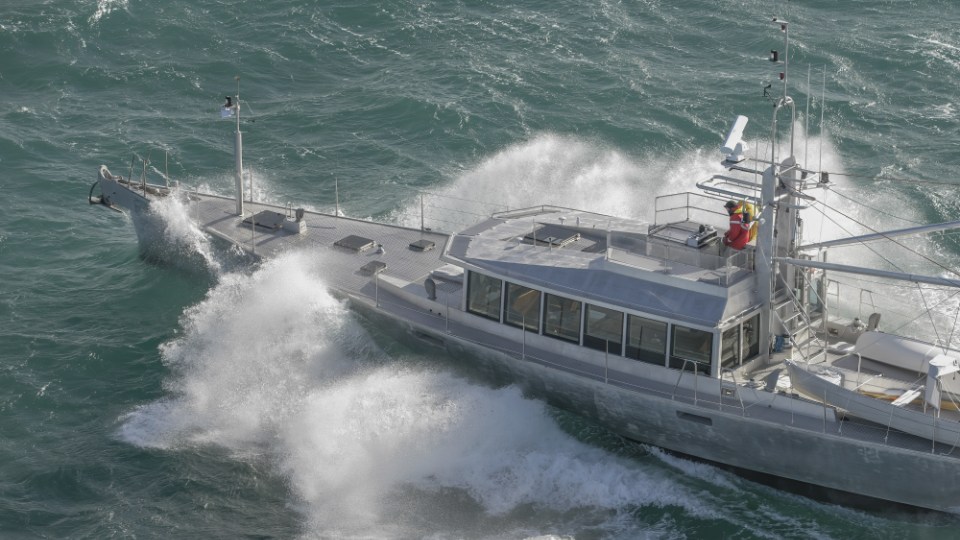
In our latest podcast episode, Sue Grant sits down with renowned yacht designer, sailor and author Steve Dashew to discuss FPB 83 WIND HORSE, the yacht that would ultimately become the foundation of the FPB fleet and help reshape thinking around offshore powerboat design.
The story begins long before WIND HORSE entered the water.
By the early 2000s, Steve and Linda Dashew had already spent decades designing, building and operating some of the most capable offshore sailing yachts afloat. Their final sailing yacht, BEOWULF, was a highly advanced 78-foot water-ballasted ketch capable of remarkable offshore performance.
Yet a significant rig failure forced them to step back and reassess.
As Steve explains during the podcast, they realised that if they embarked on another major sailing yacht project, they would be well into their sixties before the boat was completed. At that point, they began to consider an alternative.
“If we sold BEOWULF, we’d be in our early 60s by the time we got a new boat in the water.”
The answer was not another sailing yacht.
It was a powerboat.
Challenging Conventional Thinking
The idea was far from universally accepted.
In fact, Steve recalls that many experienced voices within the industry believed the concept simply wouldn’t work.
“Everybody said we were nuts.”
The challenge was straightforward in theory but incredibly difficult in practice.
Could a powerboat be designed specifically for long-range offshore passagemaking? Could it be efficient? Could it be comfortable? And perhaps most importantly, could it cope with heavy weather?
For Steve, this final question became the defining test.
“We knew that the bottom line was how comfortable they would be at sea and how they’d handle heavy weather.”
The Search for Heavy Weather
Many yacht owners spend considerable effort avoiding difficult conditions.
WIND HORSE was different.
While no sensible skipper actively seeks danger, Steve understood that the only way to properly evaluate the concept was to expose the yacht to challenging offshore conditions and see how she behaved.
As he explains during the conversation, design calculations and computer modelling can only take you so far.
“You really don’t know until you get the boat in the water in a confused sea state.”
That opportunity arrived during early offshore passages from New Zealand.
One particular experience remains especially memorable.
Steve describes encountering multiple crossing wave systems – conditions that often prove more uncomfortable than a single large swell.
“The seas from one direction aren’t what get you in trouble or make you uncomfortable. It’s when you get a crossing sea state, or sometimes two or three seas crossing.”
What happened next fundamentally changed his view of offshore cruising.
A Different Kind of Offshore Experience
For decades, Steve had sailed large offshore yachts.
Heavy weather meant sail changes, reefing decisions, watch systems and constant attention.
Aboard WIND HORSE, he encountered something entirely different.
“It was the most astonishing feeling when we went through that first squall, and we realised, there’s nothing to do.”
The statement sounds almost simple, but its significance is profound.
Removing the complexity of sail handling fundamentally altered the experience of offshore passagemaking. The crew remained focused, alert and engaged, but much of the physical and mental workload associated with traditional offshore sailing simply disappeared.
Looking back, Steve admits:
“I had never realised up to that point how stressful it was the way we sailed BEOWULF.”
Learning from Experience
One recurring theme throughout the conversation is the importance of practical experience.
Despite advances in modelling software, CFD analysis and modern naval architecture, Steve repeatedly returns to the idea that offshore conditions remain the ultimate proving ground.
Theoretical performance matters.
Real-world performance matters more.
“The final decisions are always made by feel.”
It is a philosophy that extends beyond hull design and into every aspect of yacht ownership.
The discussion touches on reliability, maintenance and accessibility, with Steve arguing that many problems are prevented simply by being able to inspect systems properly.
“If you have good access, then you can check things.”
The Birth of the FPB Fleet
Perhaps the most surprising part of the story is that WIND HORSE was never intended to launch a production fleet.
Steve believed the project would be the final boat he built.
“When we built WIND HORSE, we thought that was the last boat.”
The market had other ideas.
Interest arrived almost immediately.
“A few weeks later, we had deposit checks for four boats.”
From that point, the FPB story began in earnest.
What started as a personal experiment became a fleet of offshore cruising yachts that would influence yacht designers, builders and owners around the world.
Listen to the Full Episode
This conversation with Steve Dashew offers a fascinating insight into the thinking behind FPB 83 WIND HORSE, the realities of heavy weather offshore, and the lessons learned from decades of passagemaking.
For anyone interested in offshore cruising, yacht design, seamanship or the origins of the FPB fleet, it is an episode not to be missed.
– BuzzSprout
– Spotify
– Apple
– YouTube
– iHeart (US Only)
Posted by Lawrence Carter (July 29, 2026)
