
From California to New Zealand, Steve Dashew looks back at the shipyards, craftsmen, currencies and hard-earned lessons behind decades of Deerfoot, Sundeer and FPB designs.
“If you want to make a small fortune in the boat business, start with a large one.”
– BuzzSprout
– Spotify
– Apple
– YouTube
– iHeart (US Only)
Building the Dashew Boats: Shipyards, Craftsmen and Lessons Learned
From California to New Zealand, Steve Dashew looks back at the yards, craftsmen, currencies and hard-earned lessons behind decades of Dashew designs.
“If you want to make a small fortune in the boat business, start with a large one.”
After more than six decades around boatbuilding, Steve Dashew has earned the right to make the joke.
The Dashew story is usually told through the boats: the experimental Beowulf multihulls, Deerfoot and Sundeer sailing yachts, the extraordinary BEOWULF and, eventually, WIND HORSE and the FPB series.
But every one of those boats had to be built somewhere.
In this chapter of the Dashew Talking Books, Steve joins Sue Grant to trace the shipyards, builders and craftsmen behind those designs. It is a story stretching from California to New Zealand, South Africa, Denmark and Finland, shaped as much by exchange rates and individual relationships as drawings and specifications.
From a Wildcat to 18,000 Hobies
Steve’s first experience with a boatyard came in California in the late 1950s, working with Dan Sanderson and Roy Hickok at S&H Boatyard in Costa Mesa.
At the time, Steve was sailing a Thistle and regarded the new catamarans with suspicion. Then he watched a Wildcat comprehensively outperform the conventional dinghies in a Newport Beach regatta.
A test sail changed things rather quickly.
That relationship led Steve into the factory racing team and began an extraordinarily experimental period. There was the 14-foot Incomparable Eliminator, Steve’s attempt to shrink the spectacular V8-powered SK racing boats of the Colorado River into an affordable outboard. Around 350 were eventually built, although Steve remembers the first as “an absolute disaster”.
Then came the C-Class Beowulfs and some fairly uncomplicated engineering methodology:
“If something broke, we made it a little bit heavier and if something didn’t break, then we made it a little bit lighter.”
In 1974, Steve was asked to develop another catamaran. The factory produced three prototypes from his drawings, experimenting with different rigs, daggerboards and rudders while retaining Steve’s hull shape.
The result was the Hobie 18. Steve’s historical research for the podcast found a figure of approximately 18,000 boats, prompting the inevitable reflection that perhaps his design fee should have been higher.
New Zealand: Salthouse and Kelly Archer
By the late 1970s, the projects were getting considerably bigger.
One of the most important lessons Steve had learned was that choosing where to build wasn’t simply about finding the most famous yard. Economics mattered enormously.
He developed what he called his “boatyard index”, comparing skilled labour costs around the world. During the Reagan-era dollar, Steve recalls paying roughly US$8–11 an hour for European craftsmanship equivalent to work costing around US$35 an hour at Palmer Johnson in America.
“That was the chief driver.”
Currency helped lead the Dashews to Salthouse Brothers in Auckland, an old family yard where a young Kelly Archer would become one of the most important craftsmen in their boatbuilding story.
Salthouse worked on a substantial list of Dashew yachts, including the 68-foot Deerfoot cutter, 72-foot ketch Wakaroa, 68-foot Sundeer, Deerfoot 61s and a Deerfoot 63.
Archer became so important that the contract for the first two boats stipulated that he work exclusively on the Dashew projects.
And his eye for detail produced one particularly important discovery.
A calculation error meant one yacht was going to float significantly away from her intended lines. Correcting the problem led to moving machinery aft and, inadvertently, helped create the separated aft engine-room arrangement that became such a notable feature of subsequent boats.
“It wasn’t planning on our part. It was correcting a mistake, which turned out to be a brilliant correction.”
South Africa: Building for Half the Budget
Currency then moved the story again.
While cruising through Mauritius, Steve began investigating the possibility of building a hard-chine metal yacht. He was told the steel would be cheaper in South Africa, which led to conversations there about setting up an export operation.
The South African Reserve Bank operated a system involving the financial rand, through which an approved export project could effectively buy local currency at around a 40% discount. The Dashews applied. They were approved. The economics changed dramatically.
Steve recalls ultimately building for a little under half the original budget. Cen Marine in Cape Town produced work on two Deerfoot 62 projects, while Steve and his team also trained local workers in their methods.
It is a recurring theme throughout the episode: the location of a boatyard was not incidental to the design programme. Currency, labour, available skills and local industry could determine whether an idea was financially possible at all.
Denmark and Finland
Europe brought another collection of builders.
In Denmark, Steve encountered the Oeland brothers, craftsmen with low overheads, good equipment and a refreshingly direct way of working. They built three 72-foot motorsailers: Deerfoot II, Interlude and Maya.
Steve remembers them simply as: “Wonderful craftsmen and a real pleasure to work with.”
Fit-out work took the Dashews to Walsteds in Svendborg, a family yard already carrying an exceptional reputation. Rod Stephens of Sparkman & Stephens told Steve it was one of his favourite yards in the world.
Walsteds fitted out the three 72-footers and also built and fitted a Deerfoot 58. Steve remembers the quality as superb, although one sea trial to Copenhagen also left him remembering just how cold Denmark could be when you had arrived without suitable clothes.
In Finland, Scandi Yachts became another important part of the story, building four 62-foot yachts after Steve encountered the work of Niise Louma and his team. Louma had previously been involved with Swan and was among the group that went on to establish Baltic Yachts.
California and a 72-Foot Downwind Flyer
Back in California came LOCURA, a 72-foot cruising ketch built by Dennis Choate.
Steve describes Choate as: “Probably the best fibreglass builder I’ve ever worked with.”
The hull was light, strong and built quickly. LOCURA was deliberately optimised for downwind sailing, and Steve recalls footage of her averaging around 14 knots while her owner steered with his feet.
She was less enthusiastic about going to windward, but that was part of the brief.
Years later, Steve understood that LOCURA had completed around three circumnavigations under different owners.
From Sundeer to BEOWULF
Then came one of the great leaps.
Steve and Linda had struggled to persuade clients to accept an unpainted aluminium yacht, so with Sundeer they decided to prove the idea themselves.
When they eventually advertised her for sale, they received three offers at the asking price within around a month. Subsequent owners considered painting her, but the bare aluminium survived.
That sale ultimately led to a conversation with Everett Pearson and TPI.
The American luxury tax had devastated boatbuilding, and Steve remembers TPI operating with only around 20% of its normal workforce. Pearson told him that if the Dashews could secure deposits for six boats, he would begin tooling.
They returned with nine deposits in roughly six weeks.
TPI would go on to build 17 Sundeer 56/60s and 10 Sundeer 64s, according to Steve’s recollection in the episode.
Then came BEOWULF, Steve and Linda’s radical “mom and pop cruiser”. Her metalwork began in the United States before the unfinished yacht headed to New Zealand, where Kelly Archer assembled a small team of master craftsmen for the interior.
Steve describes the finished work simply as “exquisitely done.”
WIND HORSE and the FPB Era
The story eventually returned to New Zealand once again.
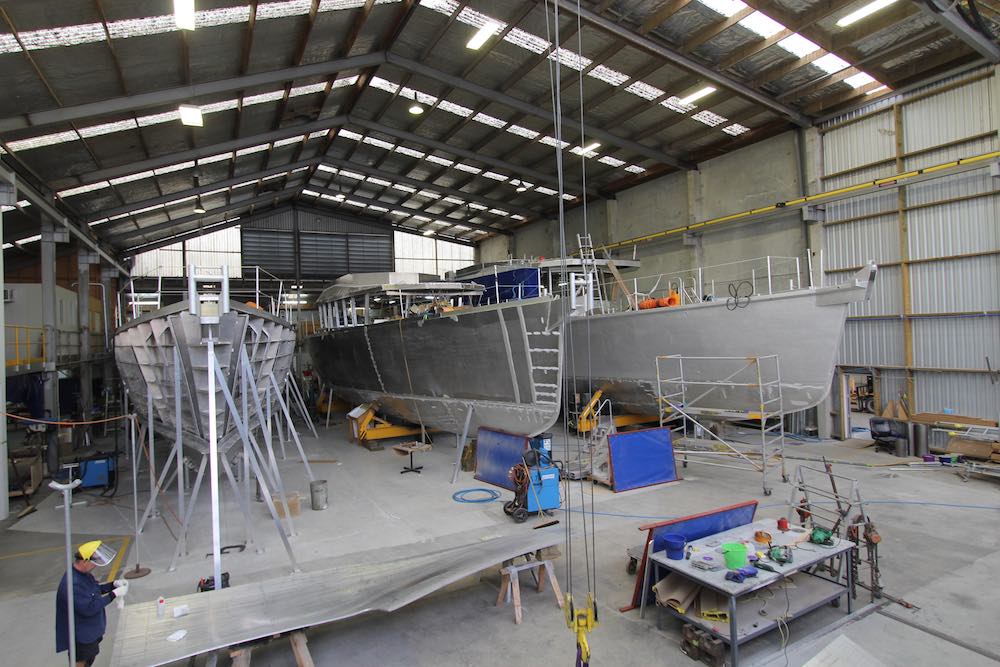
For WIND HORSE, Circa fabricated the hull while Kelly Archer completed the interior. Circa subsequently became central to the FPB programme, building 11 FPB 64s, the FPB 110 ICEBERG, three FPB 78s, COCHISE, GREY WOLF and IRON LADY, and two FPB 70s.
By then, decades separated the sophisticated FPBs from that first Wildcat in California.
Yet one principle had remained remarkably consistent.
The Dashews could not simply produce a design and disappear.
“We were never able to get the boats we wanted executed unless we were intimately involved with it.”
Steve travelled repeatedly to yards, worked closely with craftsmen and occasionally even added financial contingencies when he believed a builder had priced a job too cheaply to complete it properly.
Eventually, Steve and Linda reached a simple conclusion: if they weren’t prepared to remain involved, they shouldn’t keep building boats.
The People Behind the Boats
That may be the most interesting lesson from this chapter of the Dashew story.
The boats carry the Dashew name, but behind them sits a remarkable international network of people: Dan Sanderson and Roy Hickok in California; John Salthouse and Kelly Archer in New Zealand; the teams at Cen Marine in South Africa; Niise Louma and Scandi Yachts in Finland; the Oeland brothers and Walsteds in Denmark; Dennis Choate and Everett Pearson in the United States; and Circa back in New Zealand.
Different countries. Different materials. Different methods. Different currencies.
But the same relentless involvement in how the boats were actually built.
And after decades of navigating the difficult relationship between ambitious yacht designs and the businesses tasked with turning them into reality, Steve finishes with perhaps the most appropriate piece of boatbuilding wisdom of all:
“If you want to make a small fortune in the boat business, start with a large one.”
Listen to Building the Dashew Boats: Shipyards, Craftsmen and Lessons Learned with Steve Dashew, part of the Dashew Talking Books, on YouTube, Spotify and Apple Podcasts.
– BuzzSprout
– Spotify
– Apple
– YouTube
– iHeart (US Only)
Posted by Lawrence Carter (November 16, 2026)
