We’ve been hauled by Jarrette Bay and the first order of business is an inspection of the bottom. We are not displeased with what we see. Starting with the props, painted with “Prop Speed” four months ago, and they look very clean.
Steve and Linda write a regular column for SetSailors from wherever they happen to be. Join in as they cruise the world and discuss topics of interest to sailors everywhere. Here you’ll find their articles dating from 1996 to the present.

We’ve been hauled by Jarrette Bay and the first order of business is an inspection of the bottom. We are not displeased with what we see. Starting with the props, painted with “Prop Speed” four months ago, and they look very clean.

Wind Horse now has 5700+ hours on her two little John Deere diesels, over 50,000 nautical miles of cruising the oceans. If you have looked at “experienced” exhaust systems, you will know that an exhaust this clean after almost 6000 hours is the exception rather than the rule.

We were just talking about significant one third highest wave heights and how this compares to what you may encounter. The graphic above and photo below are a partial explanation from Mariner’s Weather Handbook (the link will take you to the table of contents)
“Hi Steve. Speaking of storms and weather patterns what do you think about the low off the east coat. Looked ominous on the surface charts and even more so on the 500 mb charts. Some weather sites are calling it a low pressure “bomb”. I have read your Mariners Weather Handbook a few times through and this system seemed like a good learning opportunity.”

Thanks for the heads up, Mike:
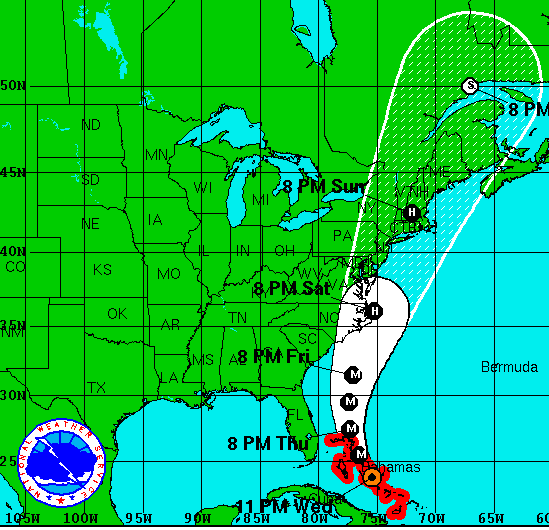
For anyone interested in weather, this is what gets the adrenalin flowing at the Ocean Prediction Center. Right now this is just a hurricane strength storm forecast, bad enough if you are caught in it,

While our usual fair is more extreme weather than this video depicts, there are some lessons for us here as well, not the least of which is the efficiency at work you are about to watch on your computer screen. The video was shot by Brian Rickard on a recent cruise with the Henrys aboard the FPB 64 Sarah Sarah, in British Columbia.
Sarah Sarah has a full payload of the Henry’s gear aboard and half tanks. She weighs around 80,000 pounds / 36,000kg, and is running at nine knots through the water (net of current). This is a speed length ratio of 1.15, on the low side of where the FPB 64s normally operate in smooth water.

Wind Horse has finished her seventh season of cruising, there are 5600 hours on her engines, and more than 50,000 miles have passed under her svelte canoe body. She has traveled from New Zealand to Alaska, through Panama to Greenland, across the North Atlantic to the British Isles, and cruised Norway to Svalbard and the Arctic ice pack to within 600 miles of the North Pole. She has coasted Spain, been with the glitterati in the Balearic Islands, and set a record in the ARC from the Canary Islands to the Caribbean, that could stand for a long time. She made it fom Las Palmas to St. Lucia (across the Atlantic) to Fort Lauderdale, Florida, and on to Marathon without stopping for fuel. This year has been less ambitious, with just the East Coast of the US to Maine and back on the itinerary. All of this in comfort, with minimal maintenance, and a very limited list of gremlins.
So, we think Wind Horse is due for a bit of pampering.

We were tied up at the Jarrett Bay boat yard complex yesterday, doing a bit of preliminary planning with Corey McMahon who will be handling our seven year itch list, when a couple of interesting photo ops passed by. There is a pod of dolphins hanging out off the docks and occasionally riding bow waves (it is hard to concentrate on boat project dialog when the pod is playing in the background).
What was interesting is the boats whose bow waves they chose to ride. There appears to be direct correlation between hull efficiency, or lack there of, and the dolphin’s favorites.

We’re on our way south, with the crowd. At the beginning of the Intra Coastal Waterway, Great Bridge, near Norfolk, Virginia, things are a bit crowded. But they quickly thin out, and for the most part we’ve been able to find the quiet waterways and anchorages which are to our liking.
“I witnessed first hand how well the boat handles up-swell at various speeds.”
–Bill Parlatore, Passagemaker Magazine
Sitting here at anchor off to the side of of the Intra Coastal Waterway affords the opportunity of studying hull shapes and their wave trains. What we have for you here are several different shapes, each with a unique shape to their disturbance pattern. The boat above is about 35-feet long and is throwing a huge wake, not a sign of efficiency! Read the rest »

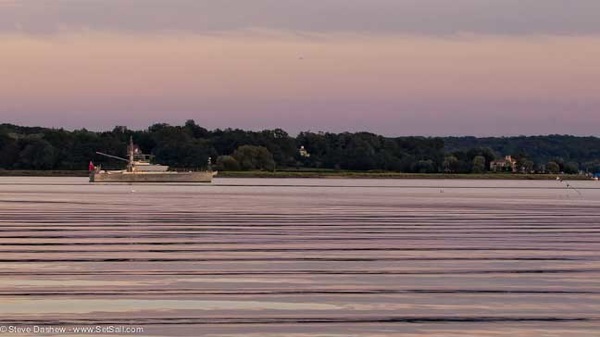
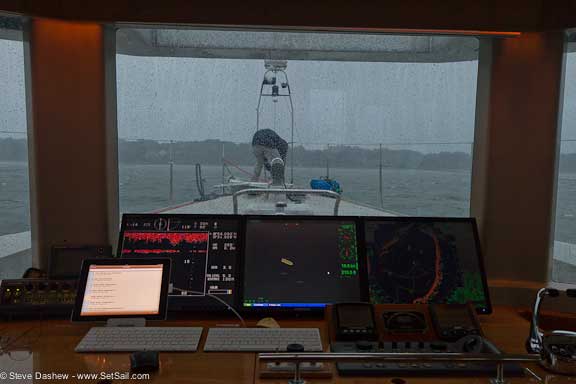
Weather that has folks scurrying for cover often holds the most dramatic impact. If you happen to be anchored in a totally protected body of water, with the pick well dug in, you can concentrate on soaking up the view.

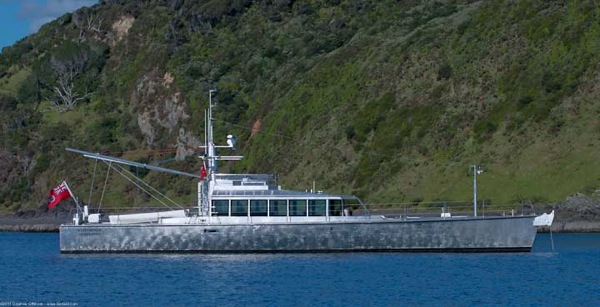
We love the visually textured finish of bare aluminum. The way light plays on the surface presents an ever changing canvas, never boring, always something a little different, elegant in an understated way. But if you are new to the look it can take a while to fall in love with the appearance (it is much easier to become enamored with the wonderful benefits). Almost everyone likes the shiny new finish. The issue, if there is one, comes as the aluminum goes through a natural aging process, and the shine dulls. The profile view of the FPB 115, above, has its surface finish picked up from a photograph of Wind Horse when she was just launched. We have other versions following with a paint job for comparison.

A while ago we wrote up the details on the FPB 64 Iron Lady’s interaction with a Fijian Reef. She is in New Zealand now, hauled out near Circa, and we’ve been studying the photos and talking to her owner, Pete Rossin, to get a better feel for the conditions. What we have learned has caused us to rethink our normal tactics when aground in difficult situations for the FPB 64s.
As you go to sea, you probably harbor in the back of your mind the particular weaknesses of your vessel. If unfavorable weather is forecast, it is often these weaknesses, coupled with a lack of confidence that create tension, concern, and fear.

In the spring of 2010 the sail training vessel Concordia was capsized and lost off the coast of Brazil. The crew was rescued and the blame was fixed on an unforeseeable microburst. The Canadian Transport Safety Board has now issued a report covering the incident, which makes for interesting reading.
A couple of points we take away from a quick perusal.

One of the things we love about this business is recieving family photos. This series is of a Deerfoot 61, built in fiberglass at Salthouse Brothers in Auckland, under Kelly Archers’s watchful eye. Of historical interest may be the fact that hull shape is the first to be built from lines drawn with the then amazingly powerful HP 6800 work station running George Hazen’s Fast Yacht.

Cruising is a fulfilling life style. It provides an ever changing mix of people, environment and challenges. When you are new to it there’s a sense of wonder. This comes from a combination of incredulity that it took so long to make the decision to get away, simple pleasure in the achievement, and just being afloat. After a while this new lifestyle becomes the norm; it can even grow a touch stale, and at some point a break is warranted.
Thirty years ago, when we were cruising full time with the kids, we’d move ashore once a year for three to six weeks. This left the boat free for maintenance projects, and gave all of us a chance to delve more deeply into the local milieu. We would come back aboard with a renewed sense of the uniqueness of our lifestyle. In more recent decades, with a home and water base, the change in scenery is, in theory, built in.
But there is a hitch.
Last week, while driving with a friend through Colorado, Montana, and Wyoming, we were asked why our yachts look so different from the norm. That got us into a discussion about beauty, function, and environment (we’ll post some photos from that drive in a few days).
We have always believed that a yacht should make your heart sing, especially when viewed from the dinghy. And while some forms of art – yachts being included in this category – are an acquired taste, there are certain absolutes. Proportions, flow of lines, detailing commensurate with the overall design, are part of this equation. So to is how the object fits into its environment. Art on land is one thing. But when you take it to sea there are other issues. It is here that as Frank Lloyd Wright said “form follows function”. The more frequently one leaves the marina and the further one travels, the more absolute these seagoing considerations. Read the rest »
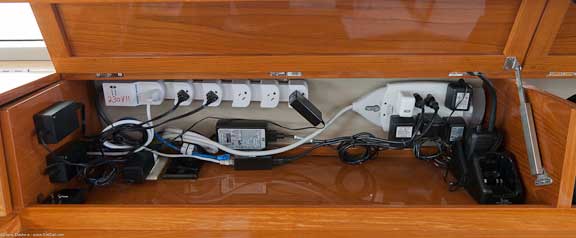
Here is a surprising look at some, but not all, of the items on charge or requiring charging transformers on Wind Horse.

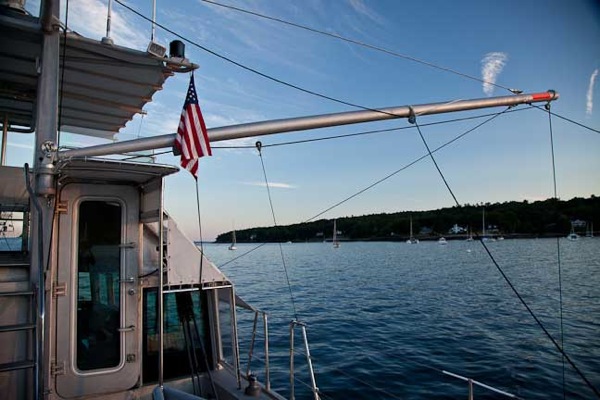
For our at anchor roll control devices we use a halyard which runs from a block at the end of t he boom, inboard to a rope clutch. The problem is that in bouncy anchorages the halyard sometimes slaps the boom, which is annoying.
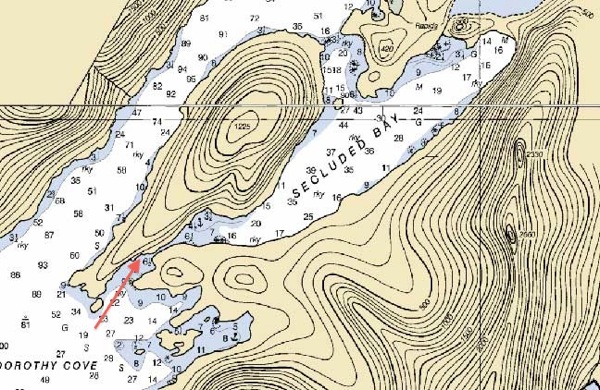
It is Saturday afternoon, football so far is boring, and having been on land now for almost a week we’ve been talking about some of our favorite anchorages. That lead to the thought that it might be nice to share a few of these with you. We’ll start with Secluded Bay, on the West Coast of Baranof Island, in Southeast Alaska. The arrow above points to the very narrow entrance. This was deep enough for the five toot (1.5m) draft on Wind Horse, but so narrow that the tree branches barely cleared our booms. Read the rest »
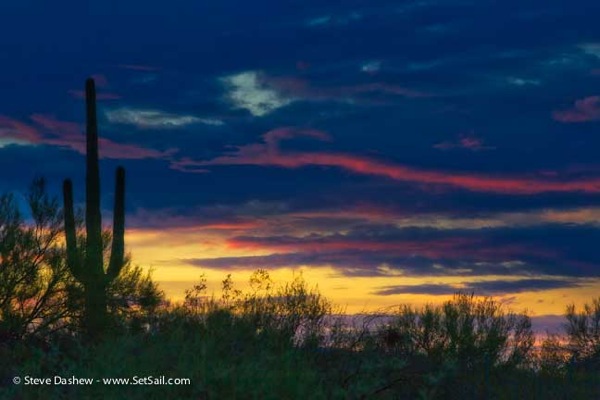
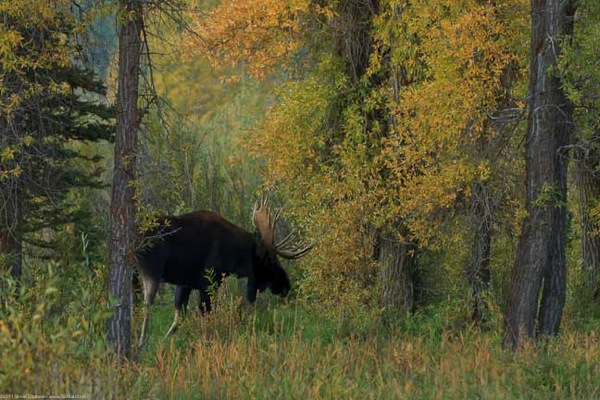
Your humble correspondents are taking a short break from work (which is what cruising while being involved full time in the marine business represents) and heading north toward Yellowstone National Park after a short visit to Arizona. We are looking forward to a week of trees, critters who are either hungry, horney, or just unpleasant in demeanor, and cool weather.

Cape May, Delaware Bay, and the C and D Canal lie in our wake. Time is short, there is a date on land coming up, and we have only been able to get a sniff of these interesting areas.
The locals are out in numbers, taking a last fling at summer freedom.

We’ve known for many years that the best way to cruise is without schedule or preconceived ideas about destinations. Staying flexible, being open to opportunity, and making fewer, in depth stops is the most rewarding of cruising rythms. Our visit to Cumberland Island is a good example of how this is supposed to work.

The air is cool and clear, Oyster Bay is once again filled with birds, and the roar of tropical storm Irene is quickly fading from memory. We have a busy couple of weeks ahead with Wind Horse, and then we return to Arizona for a month. Before the lessons learned fade we thought a few observations might be in order.

1130, the sun has peaked through the clouds for a few minutes, and the barometer has bottomed out at a relatively high 971mb.

We’ve had a squally night, filled the water tanks, but no major excitement. Michael Jones took this shot of Steve checking and adjusting the snubbers.

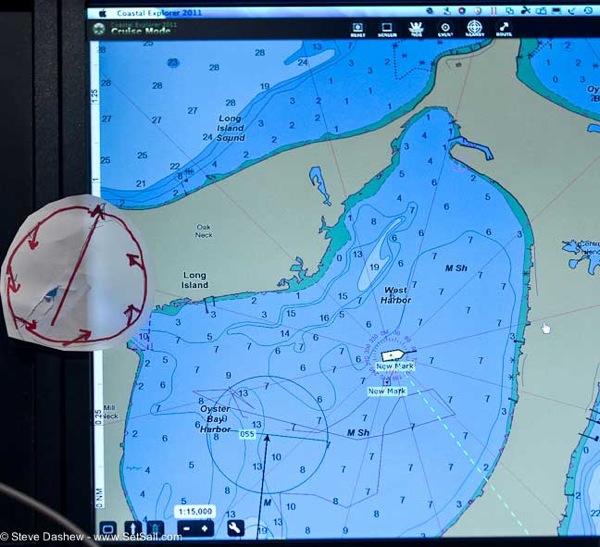
We’ve moved a short distance to the east and reset the anchor. Winds so far are east to northeast, at anything from a few to 25 knots. The drawing upper left represents the circulation of a northern hemisphere depression. As you can see, the wind direction we have indicates the track is to our left or west.

1300 Saturday – Oyster Bay – we have completed hurricane preparations.
June Jones has reflaked the secondary anchor rode, so it is ready to deploy. Notice the figure eight lay to minimize the risk of fouling.

We are anchored in Oyster Bay’s West Harbor, on Long Island (west coast), getting ready for Irene’s arrival Sunday.

The last few days have seen some shockingly bad, not to mention dangerous, seamanship in crossing or close maneuvering situations. We’ll start with the example above from the narrow channel leading into Nantucket Island’s harbor.

We’ve been working our way back from Maine, with family and friends.

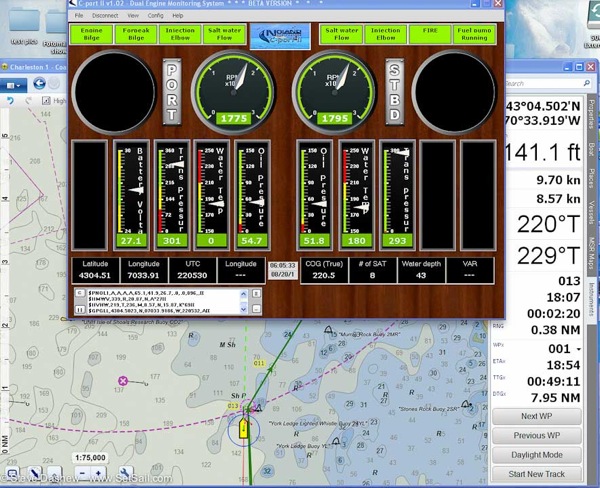
You are looking at something for which we have been waiting since before Wind Horse was launched, an analog to digital converter so we can display our analog engine gauges on the computer. It is shown above sharing the computer screen with Coastal Explorer.

It is a lazy Sunday morning in Maine and having finished our coffees, caught up with a bit of news online, and launched both dinghies for exploration and exercise later on, we thought we’d upload a few photos.

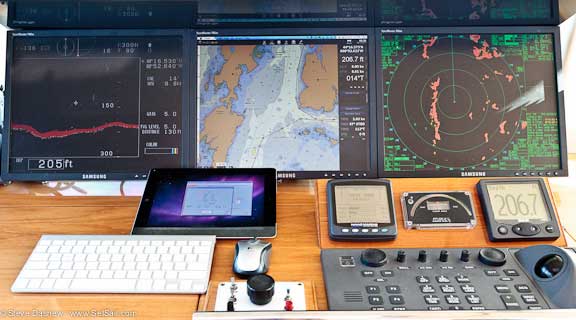
You would think with three computer screens we’d have enough “real estate” for the bridge. But that is never the case, so when Carol Parker mentioned an Ipad App called Air Display, which turns the Ipad into a second monitor for your PC or Mac, we decided to give it a try.

It has been a lovely day anchored near Brooklin, Maine. From cold rain and the first use of the heater this year, to thick fog this morning, to a warm sunny afternoon we’ve seen an amazing array of weather.

The plan for the weekend is to attend the Seven Seas Cruising Association gam in Ilseboro, Maine, and then we hear about the Eggomoggin Reach wooden boat regatta. We anguish, up anchor, and turn left rather than right, heading for Brooklin.

In our never ending quest for Internet connectivity we continue to add tools. This is a UBNT high gain directional antenna. It is mounted on our old FollowMeTV single axis tracker. Keith Smith from Towndock.net in Oriental, NC first introduced us to this unit.

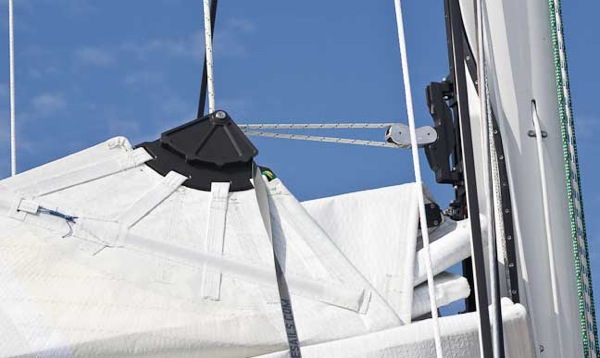
We have been admirers of the efficiency of fat head (squared top) mainsails for years. The problem in a cruising context was the top batten, When hoisting or lowering it tended to jam, often requiring someone aloft to administer assistance. When furling a fat head the headboard needed to be detached from the mast to allow the upper batten to lie down. There may be an answer.

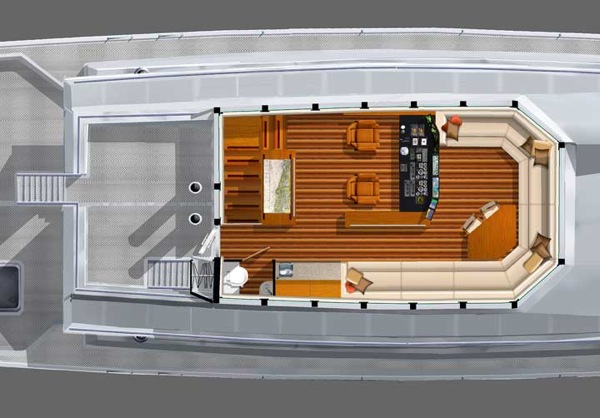
Here is a quick look at the last FPB 115 pilot house layout. We think this one is our favorite for short handed cruising.

Round Pond has worked it’s magic on us and our stay has extended. Between the sea food, quiet harbor, beautiful surroundings, and friends, if it weren’t for other committments further east, we could sit here for a month.
\

We are about to inform you about a modern miracle. There is an IPad app called Splashtop, which claimed to allow remote control of a computer from the IPad. We were dubious but figured it was worth a try.

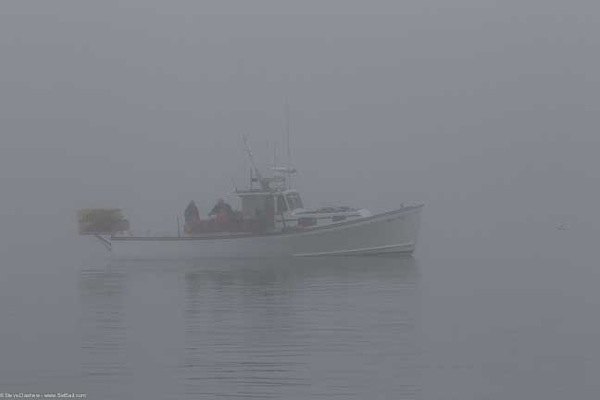
We are in lobstah territory, which means paying close attention to where we are heading and lots of dodging and weaving.

We are still behind schedule, but as we are underway from Providencetown, MA towards Round Pond, Maine, and well offshore, we are working through the last week’s photos before going back to the drawing board.

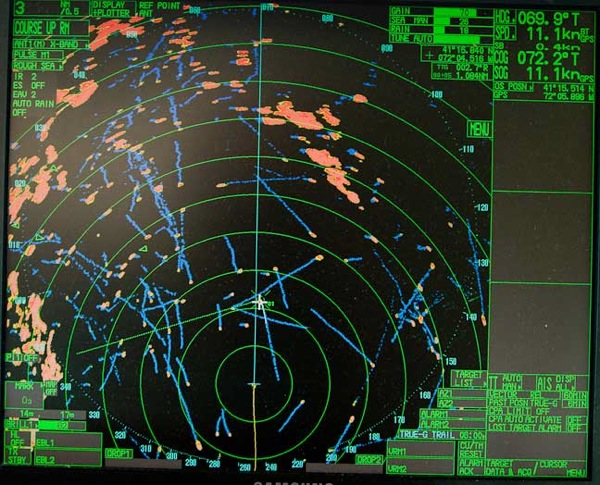
It is Saturday, hot inland, and Long Island Sound beckons those who have the means to enjoy boating. It appears to us as if most of these folks are on our radar screen (shown above on an offset three mile range).

Here is a concept for dinghies worth pondering, an inboard well for the outboard. There are many advantages.

So far this season tidal currents have had minimal impact on our planning. But from the entrance to New York harbor and north this changes. The channel that starts off Sandy Hook, New Jersey can give you three+ knots of help, or hindrance. Picking the best times used to entail laborious calculations. But now we just look at the current atlas data on any of numerous navigation computer programs, check waypoint ETA, and adjust accordingly. Sometimes this works and others it is like hitting all the red lights on your way home.

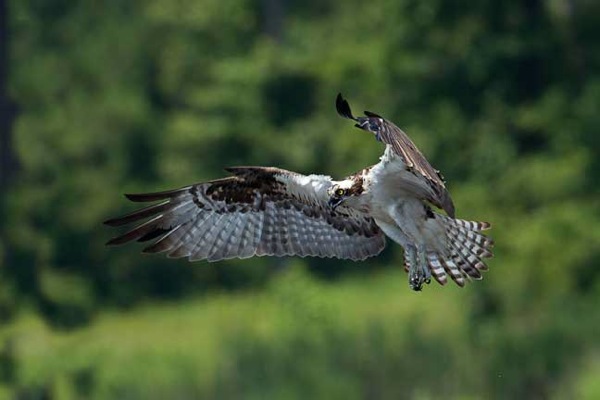
The transition from bucolic Intra Coastal Waterway and Dismal Swamp is startling. You exit the locks at t he head of the Swamp, pass a mile or two of countryside, catch osprey at their work, and then-

When it comes to being seen by other traffic nothing beats reflective orange. It shows up better than any other color in fog and rain, and is amazing when lit up at night. Many ships are so adorned, and the practice makes sense for yachts too.

One of the things we love about cruising is the variety of visual stimuli, and different life styles that come our way, in particular those with a marine flavor. In Europe we were in Cascais for an Open 60 regatta, and in Puerto Calero for the RC44 championships. Both were interesting technically, the people watching wonderful, and old world competitors do know how to throw a party.
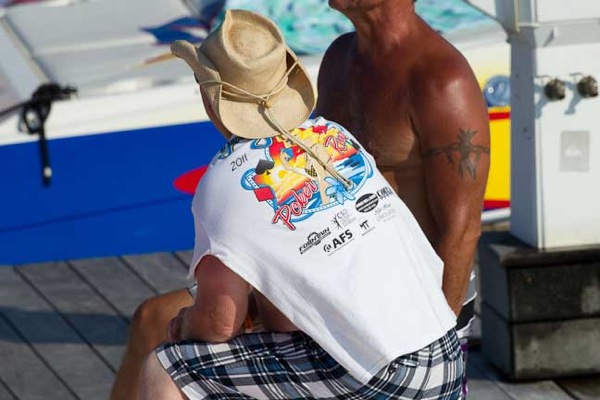
Now, from Portsmouth, Virginia, we bring you a “Poker Run.” This is an event more in keeping with NASCAR than yachting, and these folks really know how to celebrate!
Before you think we’ve gone daft from too much cohabitation with unsailing, check out the photos which follow, the slide show (although it is R rated), and short v ideo. We promise you won’t be disappointed

Where to start?
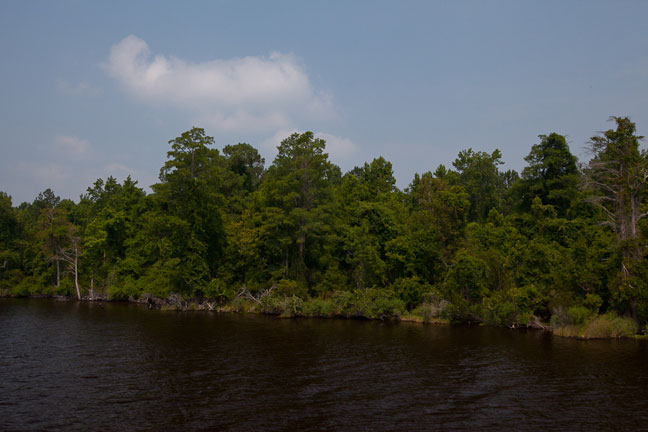
The Dismal Swamp has been a perfect ending to this little cruise along the Intra Coastal Waterway. Lovely beyond the ability of this photographer to capture; quiet, and a variety of wildlife.

We’re a day from completing the Intra Coastal Waterway. Yesterday’s run was along the Alligator River Canal, essentially a straight line which screams “boring” when viewed on a chart. We found it just the opposite.

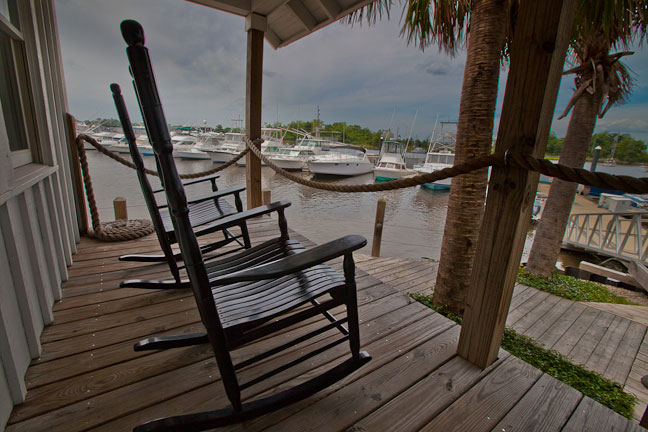
Working while cruising, especially if you are compulsive, can be difficult. Throw in enticing small towns like Georgetown, South Carolina, where the marina office features a veranda with rocking chairs – locals use them – and the schedule quickly goes out the window. We stopped here to have the folks who make our controls, Glendinning Marine, give their system an inspection. There have been a couple of unexplained glitches that we were hoping to get answers to. But while they were not able to make the time to visit us, we did enjoy meeting a former Sundeer 60 owner, and walking this very inviting town.
We have up to three computers of our own, plus the Ipad, and occasional visitors all of which need an Internet connection. But there is a single 3G USB device, which makes sharing difficult. We now have a simple answer.

Here is an interesting program from cruiser Bill Stockton that takes screen shots of Google Earth images and facilitates using them with a variety of charting programs.

We now fully understand the appeal of the Intra Coastal Waterway as a cruising environment. It is quicker, and weather permitting, easier to go outside along the East Coast of the US . But if you are cruising the Waterway, as opposed to passing through on the way elsewhere, it has a unique appeal.
We have just found the perfect Father’s Day gift, Carol Parker’s new photo collection book titled Worlds of Possibilities.

We are now into Georgia, anchored for the last few days off exquisite Cumberland Island. Nothing could better illustrate the pull of places like the Intra Coastal Waterway than the photo above. Miles of untouched wilderness, deserted beaches, interesting boats and their crew to meet, wildlife, and the occasional town, line the ICW in parts of Northern Florida, Georgia, and the Carolinas.

When we were building Wind Horse we could not find an acceptable solution to having navigation data on the flying bridge. A 10″/250mm weather resistant monitor was close to $4000. So we decided to wait until technology came up with a better answer. We didn’t expect to wait six years, but now that we are equipped with an Ipad 2 we can say the wait has been worthwhile.

There are large solar arrays on many of the cruising yachts we meet these days. A combination of high efficiency monocrystal panels and MPPT controllers makes it feasible to get most, if not all, of your systems power from the sun. Of course mounting space is always an issue.

The inlet for Saint Augustine, Florida has a well deserved negative reputation. Shallow, shifting sandbars, lots of current, and occasional strong onshore winds can make for a wicked brew. The detail on the entrance above, or rather lack thereof, is an obvious caution indicator.

A couple of years ago we fitted these vacuum gauges to our Racor air cleaners on our little diesels. They give an indication when it is time to clean or change the air intake filters.

One of the true joys of cruising is finding the odd gem of an establishment. In the case of Cocoa, Florida, this takes the form of an ancient and wonderful hardware store, perhaps the most wondrous we have visited. S.F. Travis dates back to 1885, when an itinerant merchant, who traded the Florida waters in a shoal draft ketch, established the land based store.

If you carry an outboard larger than two horsepower some thought it going to have to be given to getting it on and off the dinghy. We have always used the spinnaker halyard for this where we were not carrying the outboard already mounted. But a davit or boom mounted on the radar arch (or on its own as above) makes sense as well. The key ingredient is going to be leading the tackle to a winch to make the hoisting and lowering of the outboard easier.

There are many ways to build a good spinnaker sock, and this one has an interesting rigging detail on the control lines. Check out the red and green colors, so you can easily determine which is the port and starboard side.

Barcelona’s Port Olimpico is home to many small and medium sized sailboats, all of whom spend their lives Med moored. Almost universally they have simple, light, and inexpensive passeral systems. The one above is our favorite.

Water pump impellers, such as those on the engine or genset, are typically reliable. But they do wear, and old age takes its toll. We recently dug up a pdf file on inspection which is quite interesting.

One of the items that should be in the ship”s stores is a filled epoxy that will cure in a wet environment. This has all sorts of uses from underwater leaks to fitting repairs.

We have been experimenting with high definition videos to run as background on our big screen TV (or on the computer monitor). In theory, you should be able to download these for viewing as well. This blog is a test and we would love to get some feedback on how the quality looks, and if simple background videos like this are of interest.

We have put together a high res slide show of our favorite Florida Keys photos. To have a look click here.

One of the lessons we learned long ago is to leave fishing to the experts. So when David Kaul came by with friends Sue and Larry Hamilton, and offered us an extra mahi mahi they had aboard, being polite required we accept. Of course there is the issue of correct preparation, which Dave kindly offered to demonstrate. The photo series that follows shows the most masterful job of cleaning and filleting we have ever seen.

Thinking we were a little short on kedging details in our recent post we decided to give it another whirl. You see before you a plot of our course as we came south from our overnight anchorage in Lake Sylvia. The turn off for the New River, where a side tie awaited us, is a bit tricky and we were past it before we realized the error. In the process of turning around we drifted out of the channel, and hard aground, in a falling tide.
TowBoats US was quickly on the spot and generously offered a discounted tow for US$1000. We declined in favor of trying to kedge off, the engines being unable to do the job on their own.

Wind Horse has her bow pointed towards Fort Lauderdale for a quick stop, then we are headed north. We’re just off the 600 foot (180m) depth contour, riding the Gulf Stream making 13.5 knots over the bottom. Marathon treated us to a lovely sunrise as we cleared the deck for sea.

We’ll start this tale with an almost impossible photo of the moon from the deck of a yacht at anchor. There isn’t much light, given the small amount of moon illumination, which means a slow shutter speed necessitating a stable platform. Add in that this is a 500mm lens with a doubler, i.e. the equivalent of 1000mm, and it gets even trickier. The answer lies in an unmarked wreck in the southwest corner of Marathon harbor, where we arrived back at dead low tide. We shall spare you the details of finding the wreck as we scouted for our old anchoring position. The interesting part is what happened after we became ensnared.

Weve been anchored in a lovely channel amongst the Marquesas Keys west of Key West (off the NW corner of Boca Grande). There is good holding, a reversing current running at two to three knots, and 15 to 20 knots of breeze to keep us cool. The direction of the wind, out of the east, holds us off a steep to shoreline (there is sufficient depth for us within spitting distance of the beach). We’d normally lie on three to one scope, but in this case, with the direction of pull reversing with the current, we are at six to one – 175 feet/56m in the 20 foot/6m deep channel.