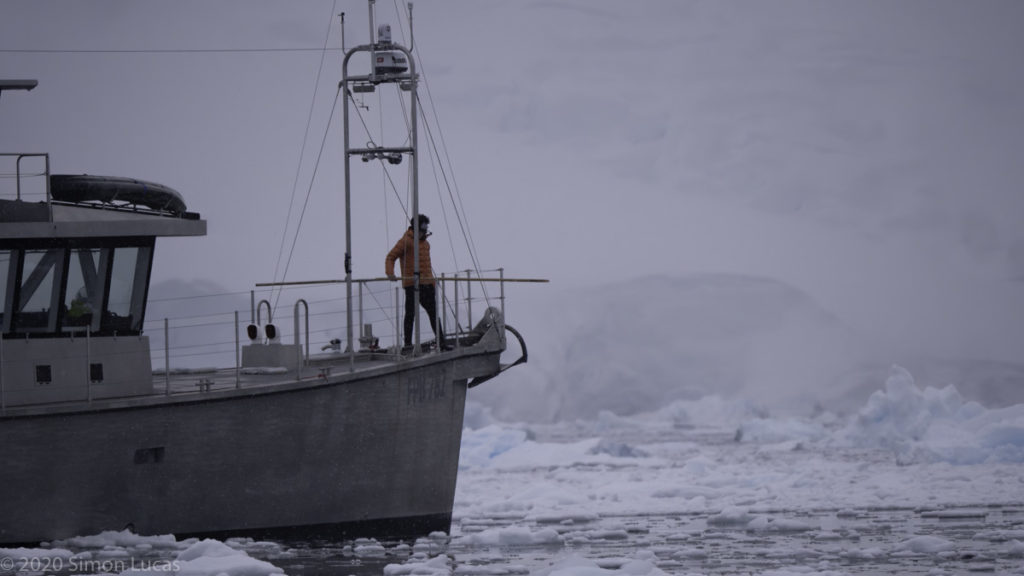
 … beautifully filmed, powerful video follows the journey of two FPB 78s as they cruise the remote and challenging Lemaire channel of Antarctica. Read the rest »
Posted by Steve Dashew (March 3, 2020) | Comments (0)

Following are the latest posts on the FPB 64 program. This section covers systems, how the FPB 64s perform in the real world, along with data on why we do things the way we do. For more information be sure to check out SetSail.com/FPB64.
… beautifully filmed, powerful video follows the journey of two FPB 78s as they cruise the remote and challenging Lemaire channel of Antarctica. Read the rest »

Join Linda and Steve Dashew aboard the FPB 78 – 1 Cochise on a 7500 mile/12,070 kilometer record setting voyage, Read the rest »

For a link to the video which show and tells it all Read the rest »
How do you create the best possible cruising yacht? Read on and we’ll share our formula. Read the rest »

I spent my first six decades on earth despising powerboats and those who operated them. In my early days of sailing dinghies, powerboats would always speed up to cross ahead of us leaving a huge wave to wreak havoc with us and our compatriots. My earliest recollection of the single finger salute was from such encounters. As cruisers, if there was a “stinkpot” around they inevitably would anchor close by and then run their genset 24 hours a day. And the lack of seamanship was stunning. Read the rest »

It is finally done (and we mean it this time)! In the post that follows we will detail the logic that lead us to to this new paradigm for navigation stations, and the details that evolved.

A new video in which we reveal the secrets behind all those ocean-crossing miles… Read the rest »

The Nespresso coffee machine hisses in the background as Linda makes a change-of-watch latte. The faint glow under the eastern clouds heralds another beautiful morning at sea. Read the rest »

FPB 97-1 Iceberg running before a stiff breeze during sea trials.
The post that follows this introduction is a chapter excerpted from the FPB 70 and 78 Owner’s Manual. Everyone who goes to sea thinks and/or worries (or should) about heavy weather, and how their vessel will handle different conditions. It doesn’t matter whether you’re on a 25,000 ton container ship, a moderate-sized sailing yacht, or one of our FPBs. We think it is better to discuss these issues openly, rather than ignore them and hope you never get caught. Read the rest »
 FPB 78-2 Matrix deck helm
The current America’s Cup spectacle has us entranced: unbelievable speed, maneuverability, and difficult sailing, the likes of which has never been seen before. The design and engineering required to achieve this level of performance is nothing short of astonishing.
The time to study what’s happening in Bermuda in detail is the result of this correspondent’s photography accident (night sky shooting on a dark dock), which resulted in a shattered kneecap and a forced hiatus from summer cruising… Read the rest »

We’ve been chasing the holy grail of the perfect cruising yacht for 40 years. The Deerfoot, Sundeer and Beowulf series are considered the premiere sailing yachts on which to circumnavigate. The FPB fleet is judged by the most experienced owners and journalists to be the best ocean-crossing motor yachts today. To find out why, read on:
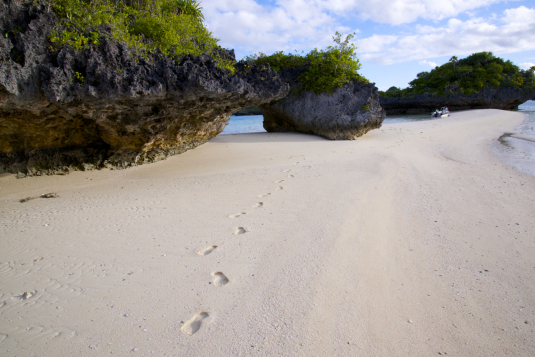 ©Stan & Valerie Creighton: Fulaga, Fiji
When your voyaging takes you off the beaten path, where shore power and technical assistance is a rarity, the ingredients required for successful cruising change.

There’s a new kid on the block, a smaller sibling to the FPB 97 and 78, and like most younger family members, this one is as tough as nails. Read the rest »

The universe of circumnavigators is a small world. It’s not unusual to meet somebody in an anchorage or a far-off port, spend a few days together, form a strong bond borne of common interests, meet up again years later, and pick up right where you left off. Read the rest »

In the fall of 2008, having visited Greenland and Ireland, we were looking for a place to store FPB 83 Wind Horse for the winter. Several of our cruising friends recommended that we talk to Berthon in Lymington, UK, and we ended up leaving her in their very capable care. Read the rest »

Insulation of the hull and deck is critical to comfortable and efficient cruising. It impacts noise levels from exterior and machinery, condensation in cold climates, and electric requirements for heating and air conditioning. With the FPB Series we take the insulation game to a new level. Read the rest »
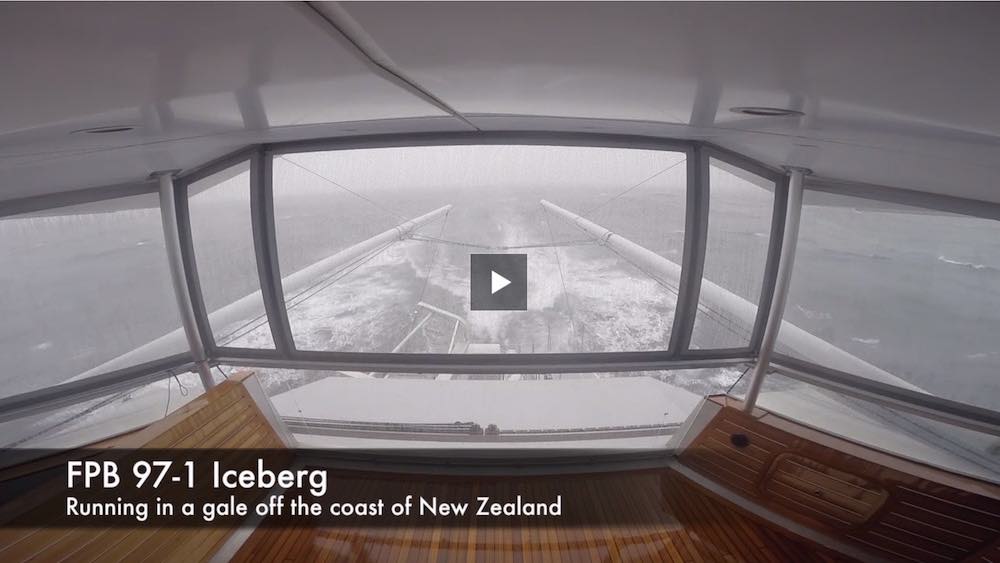
Come aboard FPB 97-1 Iceberg for a quick ride from Waiheke Island to Whangarei. Read the rest »

Being very 21st century in all things to do with serious cruising, we have a demo of a pair of ultimate cruising tools.

In the pre-dawn light, illusory figures attend the Wicked One, for it is known that this is the day.
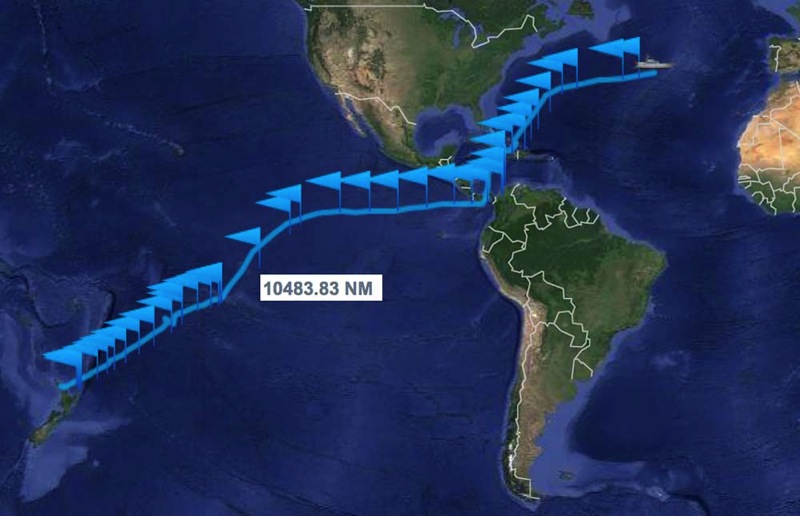
With the FPB 64 Grey Wolf covering an average of a thousand or more nautical miles per week on her voyage home, we have in effect an accelerated maintenance test to observe. Experienced cruisers and marine professionals will be surprised by the data accumulated since her departure from New Zealand the last week of March. Read the rest »

Bottom plate this thick is heavy, very difficult to fabricate, and costly in the extreme. It is two times or more the Loyds Special Service rule requirements. Does it make sense?

We are always looking for a better, simpler way of doing things, and this frequently includes in-house testing. Right now we are working on LED lighting, looking for the best combination of light, color temperature, and dimming ability.

Here in Arizona we’re excited, having received our weekly update of photos from New Zealand. Seeing progress starting to accelerate on the first of three FPB 78s now scheduled, we are leaping for joy. The assembly floor has been laid out, and the tank modules are being dropped into place.

It was six years ago (January 24th, 2008) that Steve and I first went to New Zealand to have meetings with Circa Marine in Whangarei, regarding the construction of the FPB 64. That trip, my first to New Zealand, seems like it occurred just yesterday. Two weeks ago, as Steve and I touched down in New Zealand to finalize details on the new FPB 78 with the crew at Circa, the changes and milestones reached over these past six years loomed large. Read the rest »
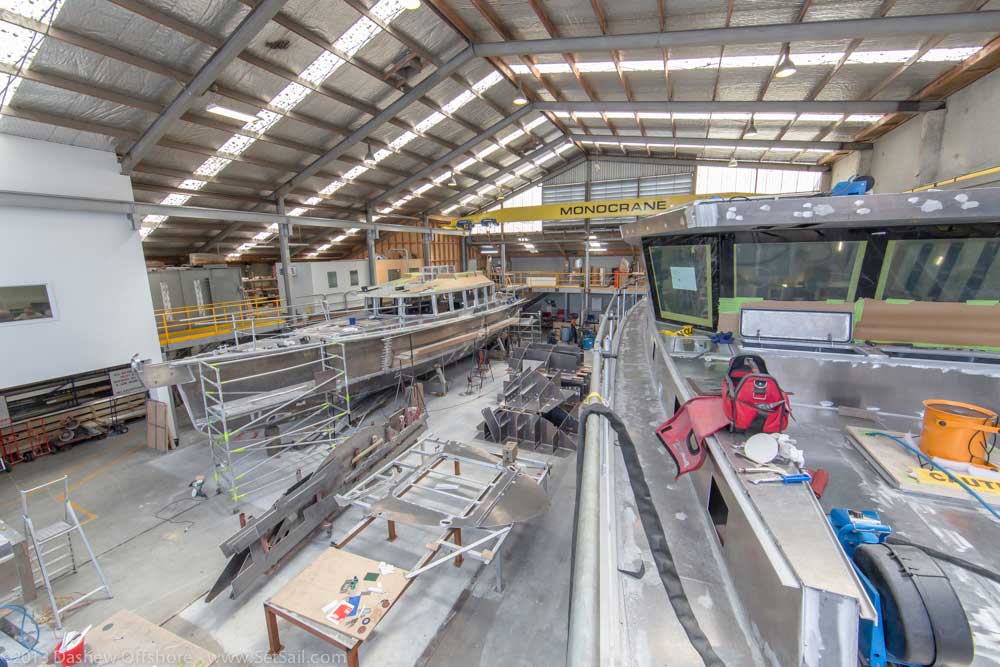
We are just back from a week at ground zero in the FPB world. We had the chance to take a couple of boat rides, hang out with three owners who are presently moored in the town basin, and review hundreds of details with the Circa team. Read the rest »

Words don’t work here. The photo is capable of speaking for itself.
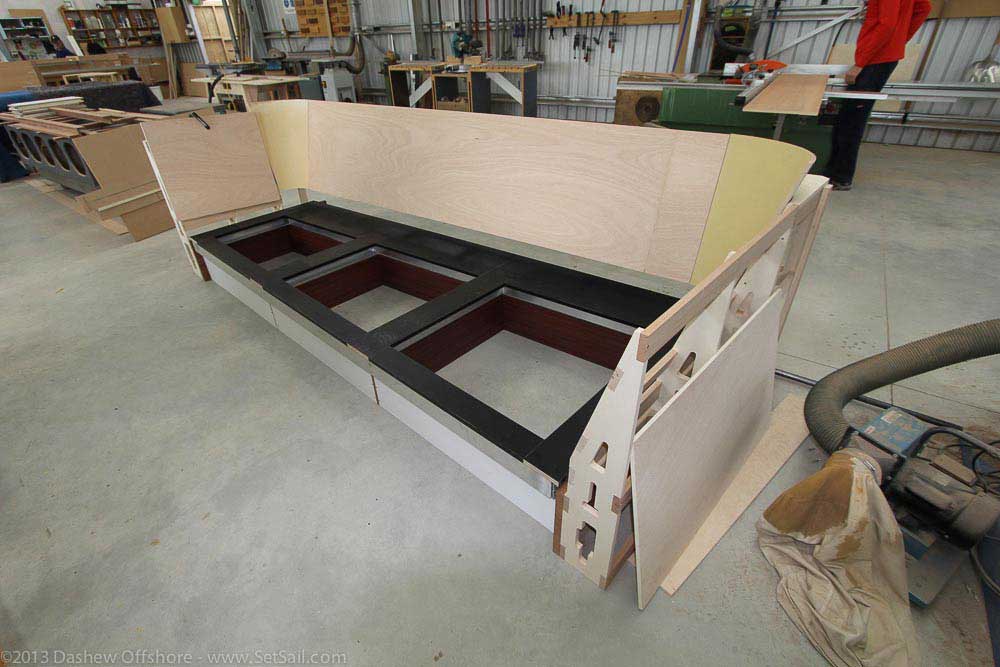
Although the furniture represents a small part of the total weight of the boat, we want it to be as light as practical, as you see here with the carcass for the FPB 97 great room settee. Read the rest »

Our thought has always been that the best indicator of success in the marine business is not units sold, or boat show pizzazz, but rather how your boats are being used. Are they sitting in marinas or out there racking up the miles, treating their owners to the world of new experiences that lay beyond the horizon?

Those of you familiar with our work will know that we consider being able to maintain comparatively fast cruising speeds the most important factor in safe, comfortable ocean crossing. Get this right and you enjoy making passages. Get it wrong and you will prefer sitting at the dock reading about the folks who are really out there cruising. Read the rest »
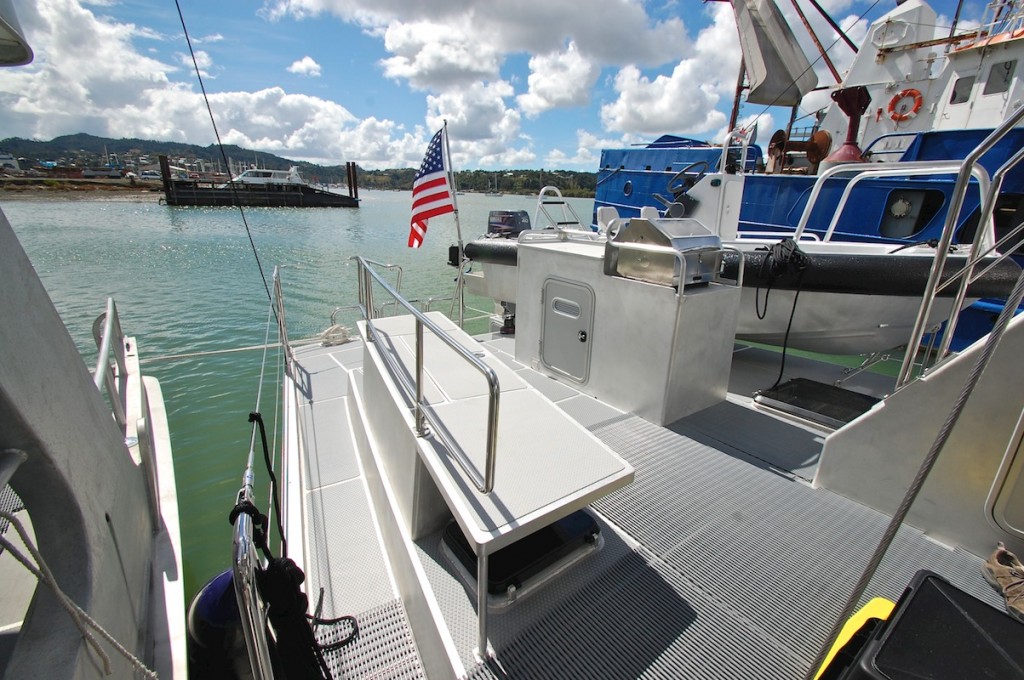
With the recent handover of FPB 64, hull #7 – Buffalo Nickel – I thought readers might enjoy seeing the two aft deck configuration options available on the FPB 64. Read the rest »
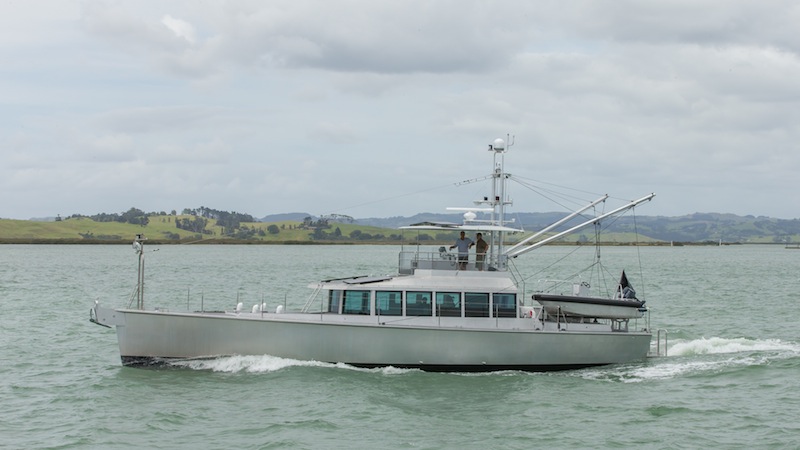
Want a taste of the FPB cycle? The following video gives an idea of the birthing process… Read the rest »

Dean Gunson, Operations Manager at Circa, is showing off a test section of rolled aluminum plate. Read the rest »
“Against the Wind…With his new powerboat design, world cruiser Steve Dashew continues a lifelong pattern of challenging the status quo.”
–Soundings Magazine

I have just returned from a very productive week in New Zealand and wanted to share some of the photos taken while on the ground at our builder, Circa Marine. There was much covered during the trip – here are a few of the latest details surrounding the FPB 64 program. Read the rest »

The Circa team is hard at work on the initial stages of FPB 97-1 fabrication, and we are starting to receive some photos of the process.
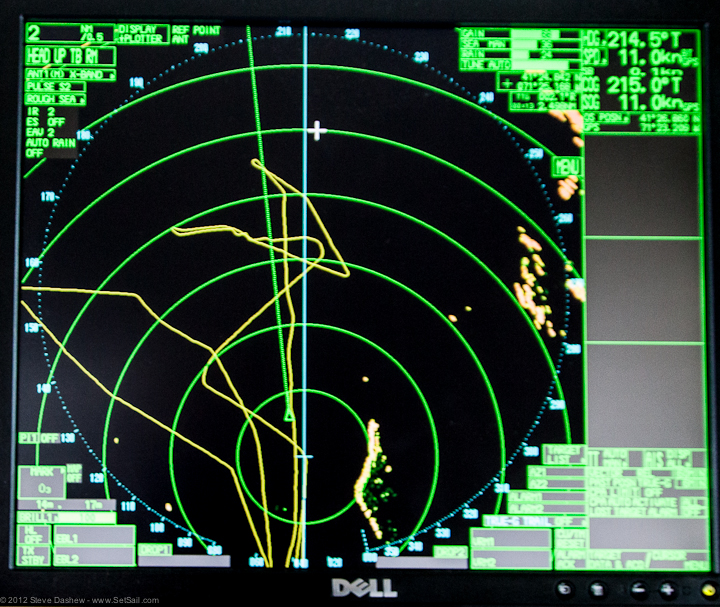
We’ve been out the past few days, testing the latest NAIAD stabilizing software on Wind Horse. We’ve had 20-to-30 knots blowing straight into Narragansett Bay with opposing and slack current, so a variety of sea states: from steep to “holy cow, look at that!” As you can see by the track above, we have been taking the waves at all angles, from dead ahead, to on the stern, and everything between. At the end of this post there are a couple of short videos.
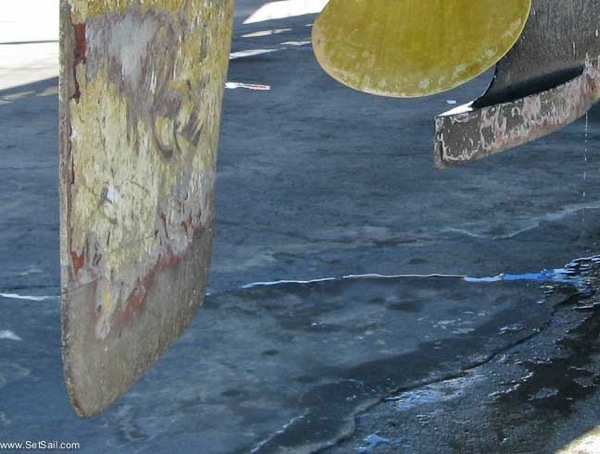
Years ago the debate about the most effective rudder for steering was settled, and the cantilevered spade configuration was the winner. But what about hitting debris, running aground, and catching nets you might be thinking.

Growing up navigating by sextant and lead line taught us to appreciate modern electronics. We love radar, GPS, SONAR, and AIS. We are attached to free wifi, and data via cell service. What we don’t like is a hodge podge of antennae strewn here and there. So the farm – as in antenna farm – is on the design priority list during the concept phase, to make sure there is an orderly way to install them all.
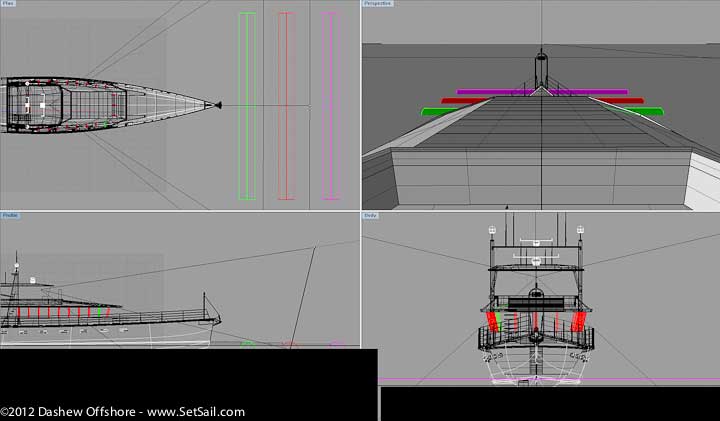
A primary design consideration is always what you can see from various places on board. As yachts get larger the sight lines diminish, and you begin to rely on secondary input: usually crew members wearing headsets, calling distance off the dock or to another vessel, to the con. We’d rather see and judge for ourselves. Hence a rigorous study early, the results of which guide the ensuing design.
There are several different criteria we are looking to fulfill:
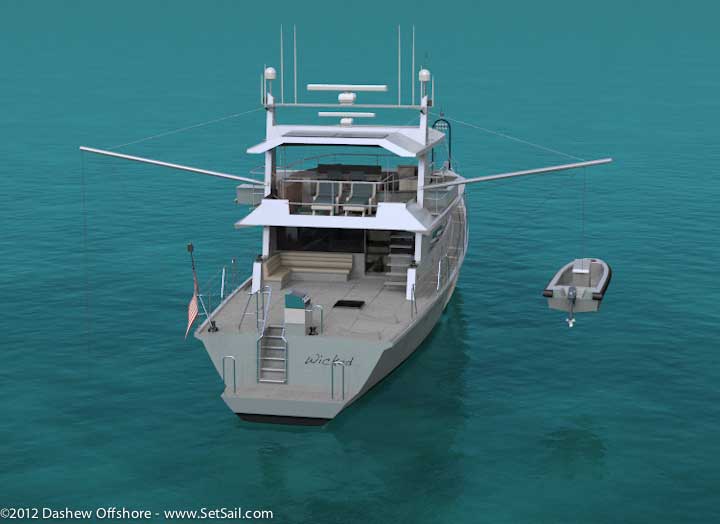
Among the very first things we look at in designing a yacht is dinghy storage, launching, and retrieval. This design aspect is as fundamental to successful cruising as anything else aboard. We have had a simple and reliable system since the first FPB first launched seven years ago, modified only recently by the advent of deck winches that power out as well as in. With booms easily controlled by permanent guys, locked off with rope clutches if required, and the dink stowed at deck level, the process is easy enough to get into and out of the water that we usually stow it aboard each evening.
As simple as this is, we still consider this to be potentially the most dangerous job on board.
With the Wicked FPB we have refined the dinghy process to make it significantly easier and more controlled.

We used to envy the folks who cruised with shallow draft for the benefits it conferred. There is the obvious, extending your cruising opportunities to areas like the Bahamas (above), but there other significant advantages as well.

We have a problem gentle reader, and we need your help. The marvelous space we so prosaically call “Pilot Deck” is worthy of a descriptor more in keeping with the view of the world from this unique space.
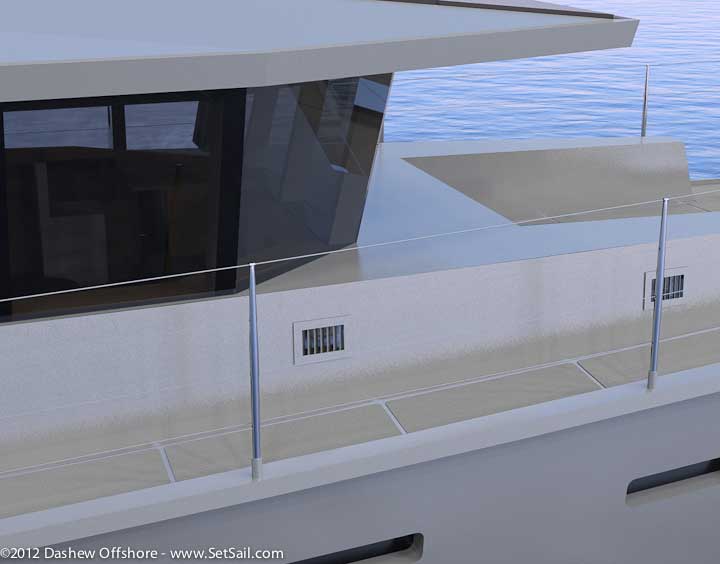
The new Wicked FPB sports some hot angles, not the least of which is the glazing system surrounding the great room. There are numerous advantages to these outwardly angled windows.
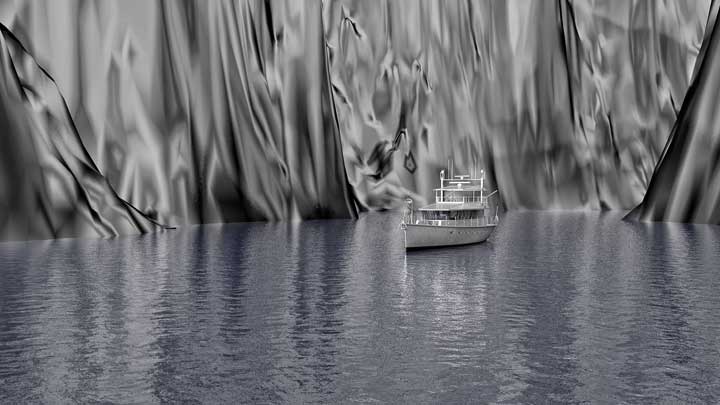
Throughout history, the most successful seagoing vessels have shared common attributes. Take, for example, the greatest warriors and travelers of their time, the fiercesome Vikings. When they sallied forth from their northland fjords, they employed high speed, extremely maneuverable, shallow draft designs to help them expand and conquer their world.
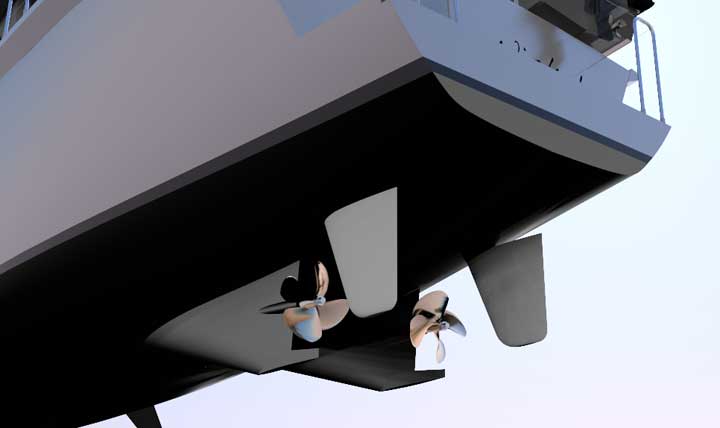
If you are a regular visitor to SetSail.com, you know we like fine rear ends. Flat buttock lines in particular arouse our instincts. With most yacht designs, there is a conflict here between comfort and performance (and this varies with different speeds, or more correctly speed-length ratios). Typically, you pick a speed regime and sea state and live with the results.
But if you stretch the waterline, keeping other design aspects constant, good things begin to happen.
We took the afternoon off, went for a drive, had a gelato, and enjoyed being outside in the harsh winter for which Arizona is known. We’re down to rechecking basic assumptions (again), finalizing deck geometry, and fine tuning the hull shape. This can be a dangerous time in the design cycle.

We are somewhat surprised by the amount of comment induced by the post on the solar array, so we thought we’d update you to the present (things are moving quickly).

When you start to consider powerboat (stinkpot) systems, virtually every decision revolves around air conditioning. Air conditioning holds you hostage. High heat loads from large windows and poor-to-nonexistent shading, coupled with a lack of ventilation, force you to fit large compressors, which means a big genset. Since you cannot do without the genset, you need a second, both of which are too big to just run air conditioning at night, so a small night generator is needed. All other systems decisions flow from this conundrum.
But what if you had good ventilation, even when there was no breeze, and then coupled this with minimized heat loads?
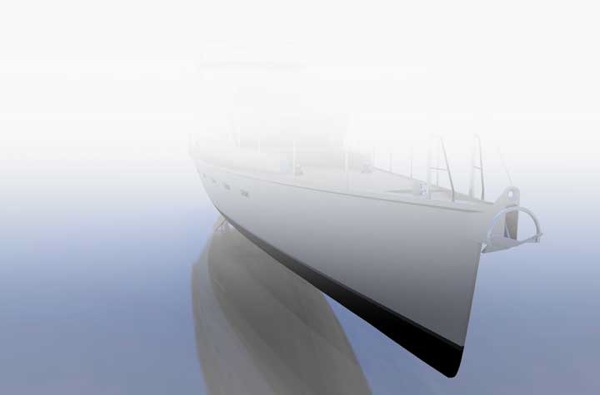
Most of the folks we know in the marine “business” (an oxymoron for sure) play the game for love, or because they simply have no choice, they are pulled to it. The hours are long, the outcome often uncertain, and the risks higher than many economic endeavors.

For years we’ve been wrestling with a way to improve on the FPB 83, Wind Horse. We’ve done smaller, as in the FPB 64: a very efficient, attractively priced, well-mannered yacht. And we’ve worked up a larger version in the guise of the FPB 115, about which we can get excited. But to improve on the Wind Horse combination of comfort, sea-kindliness, heavy weather ability, trans-ocean average speed, systems efficiency, and ease of handling for a couple has yet to happen.
It starts as a hazy vision one sleepless night, an outline, and there is a compulsion to see where it leads, even if it is not on the master plan. When the beast strikes, you have to feed it – there is no other option. Days are long, nights are short, computers whirr overtime and the design spiral fits seamlessly together. Gigabytes criss-cross the internet. Hydrostatics, structure, layout, motion, systems, ventilation, aesthetics – meld wickedly, as if this were meant to be.
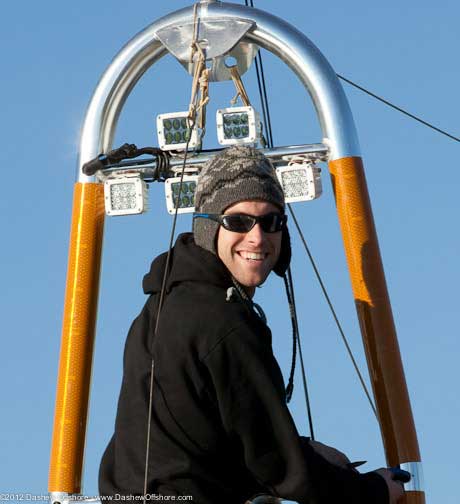
Some years ago we installed a 1000 watt 230 VAC Aqua Signal flood light on the forward mast. It proved useful on occasion for checking sea-state at night, and maybe once or twice a year looking over anchorages in the dark. When Todd Rickard and Mark Fritzer visited IBEX last fall they ran into a company selling high intensity LED spots and floods called Rigid Industries. They were impressed, so we decided to give a set of these a test on the new forward mast on Wind Horse. That’s Chris Martin of Martin Engineering doing the install.
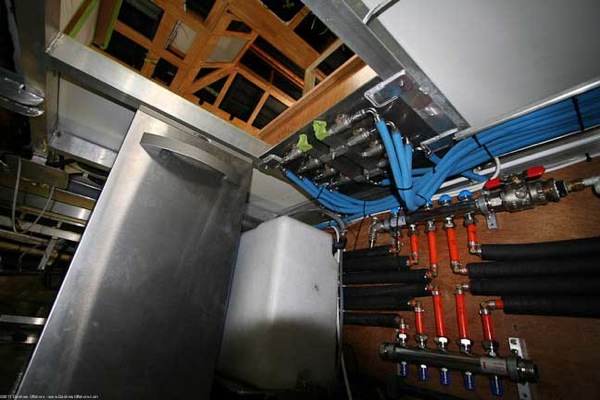
A new year is upon us and we are in catch up mode. We are a month behind in posting FPB 64 photos from the production line, so we shall endeavor to bring you up to date in one huge post.
We’ve been through the drive line and are about to reassemble things, have checked the tanks, and the rest of the systems, with very little wear and tear to show for our 5700 hours and 57,000 miles +/- of travel. As we’ve done a series of posts scattered here and there on this subject, perhaps a recap is in order. We’ll then give you a brief rundown on changes we are making and why.
But first, a few thoughts on maintenance, frustration, and costs of ownership. Read the rest »
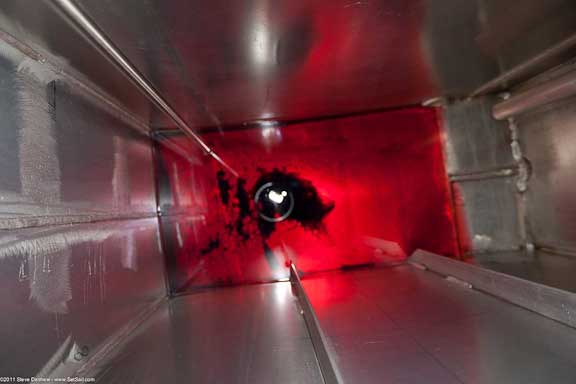
Corey McMahon and cohorts have been working on “the list” and this afternoon’s feature was an inspection of the diesel tanks. After 5700 hours of engine time over 6.5 years, and more than 40,000 US gallons (170,000 L) of diesel, sourced all over the world, we were more than a little curious as to what we would find.
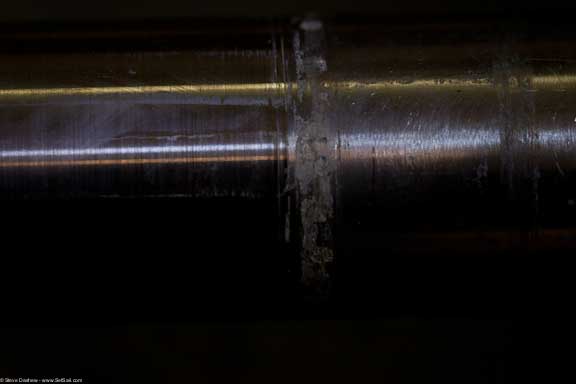
The prop shafts have been removed (they slide past the rudders) and we’ve given them a close look. The cutlass bearings are both still within tolerance, with the starboard bearing showing no wear. The port bearing has on the order of 1/8″ (3mm) of slop, not much really.
However, we are replacing both since the shafts are now out. The shafts show almost no cutlass bearing where.
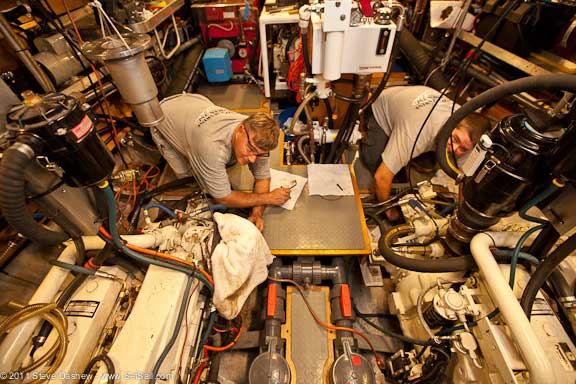
Corey (left) and Casey (right), from the Triton Marine crew, head down and tails up, taking the drive lines apart on Wind Horse. After 5700 hours we want to have a detailed look at the various elements to see how they are wearing.

Over the last 30 years we’ve been involved in many aluminum and fiberglass yacht construction projects. Our experience has been that properly built, aluminum holds a substatial edge overall in maintenance issues. “But what about corrosion, and the horror stories that are rumored?” you might be thinking.
To anwser that we offer the photos above and below. Those are sacrificial zincs, formerly attached to the hull of Wind Horse as sacrificial anodes, so that any corrosion comes off their mass rather than the hull.

The passage from the tropical South Pacific island nation of Fiji, south to New Zealand, is one of the more difficult you will find. There is a high risk of heavy weather, sometimes extreme, that every year catches a few yachts. Obviously it is best to avoid this form of unpleasantness. The key is boat speed, understanding weather, and patience. But even the professionals occasionally get caught so it is advisable to be prepared.
This was the case last week with FPB 64-1 Avatar. During her passage to New Zealand she had two days of force eight gales on the nose, gusting force nine (35 to 40 knots gusting 49). As much as we’d have preferred for Avatar and crew to have an easier trip, these conditions generated exceptionally valuable data, as we shall shortly see
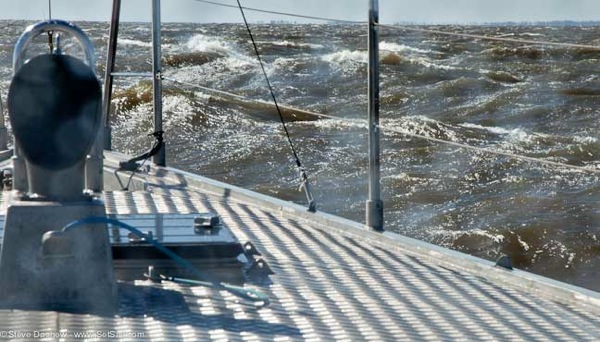
Predicting performance under power is relatively simple if you have a hull form that fits standard models (the definition of standard here covers a gamut of fishing trawlers to high speed destroyer hulls). In the olden days you would look up David Taylor model test data for something similar and then go to work with your slide rule. More recently, this process has become quicker, with the ubitquitous computer filling in for the retired slide rule. But if you pick the wrong model data, or miss something in your hull characteristics, the resulting calcs can be off, sometimes by a lot.
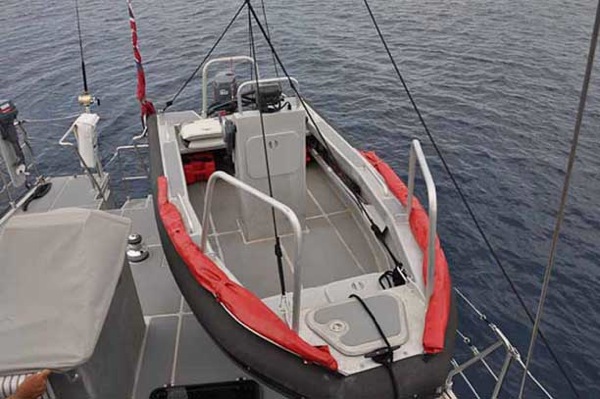
Launching and retrieval of a large dinghy is probably the riskiest endeavor on any yacht. Pete Rossin, of Iron Lady (FPB64-3), has written up the system he uses, the link for which is at the end of this article. Before checking his blog, here are some things for owners of all types of vessels to consider in the dinghy handling process.
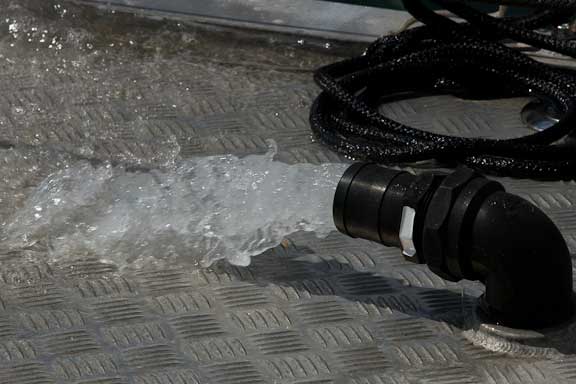
We fit damage control (crash ) pumps to all our yachts. These are plumbed with a single line throughout, and Ts with valves in each watertight section. Although the pumps are self priming, the slightest leak, especially to the forepeak, and they won’t draw. So a periodic test is a good idea.

Denied the capacity to fiddle with rig and sails, we have filled this void by experimenting with props. Our three bladed test being concluded after 8000+ miles of usage, we are back to the fours.
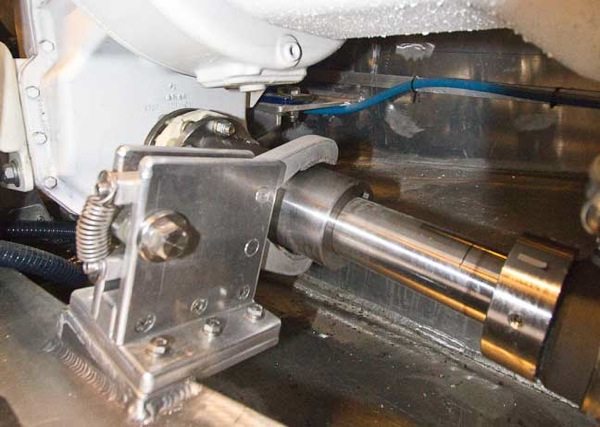
There are two interesting points about this photo of the inboard end of the FPB64 prop shaft.
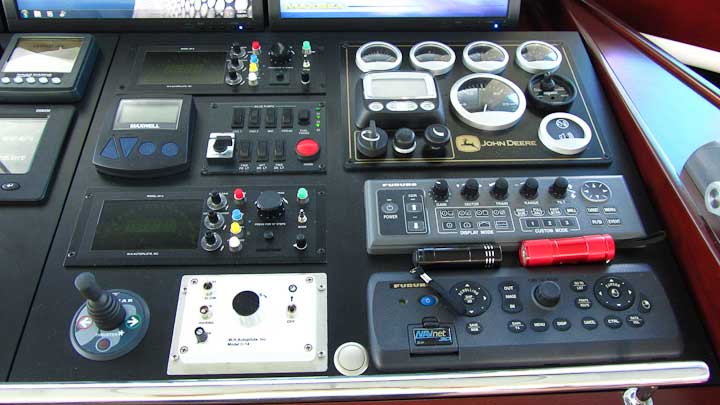
A couple of notes from the FPB 64s.
Pete Rossin (FPB 64-3) has a detailed look at his navigation station on the Iron Lady website. You can see lots of photos and read Pete’s comments on how he is using this gear by clicking here.
Osprey (FPB 64-4) has safely crossed what many consider the most dangerous chunk of ocean inside of 40 degrees of latitude, the Tasman Sea. As often happens, the forecast gale morphed into 55 to 65 knots (storm force), blowing against the South Australian current. And the Coffs Harbor entrance bar, which they had been told was passable, actually had a 12 to 15 foot break across the entrance. We’ve chatted with the crew and will have a detailed update once we have finished the debrief. Right now we know that the boat behaved as expected, and dealt with the conditions with aplomb.
We have discussed the merits and demerits of wet and dry exhausts in the past. After much study, and dialog with commercial and pleasure users, we opted for a wet system on Wind Horse and saw no reason to change with the FPB 64s. Recently we were challenged on this subject, and after answering, challenged again, with the point (amongst others) that Nordhavn has been successful marketing dry exhaust systems. Which brings us an axiom we learned long ago. To wit, successful marketing and good results in the real world of long distance cruising are rarely synonymous. Rather, it is better to execute based on first principles and sound logic.
Since you already know which side we come down on, we thought it would interesting to share the opinions of two former Nordhavn owners, now FPB clients, who have lived with dry exhausts,
We have just received a shipment of high definition DVDs filled with action footage of the first three FPB 64s during sea trials in less than ideal conditions. There are hundreds of photos as well. If you have wondered what these yachts are like offshore, watch this video and its more than 75 minutes of action. Available for just $12.95 + S/H by clicking here. Or, you can enjoy the fun by viewing online at SetSail.com
Better yet, order Sea Trials and Off The Beaten Path (with 115 minutes of cruising aboard the FPB prototype, Wind Horse) together and get free shipping in the continental USA. Details are here.
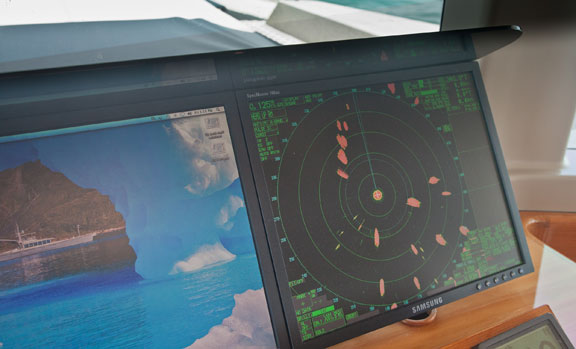
One of the things that has long been overdue onboard Wind Horse is a glare shield for the three navigation monitors. Working with Greg Kelchner in Fort Lauderdale we fashioned a variety of mock ups from thin plywood.

We have dragged these two oversized strainers around for the past 50,000 miles. Other than an end of season cleaning only once have they needed to be emptied – until today.
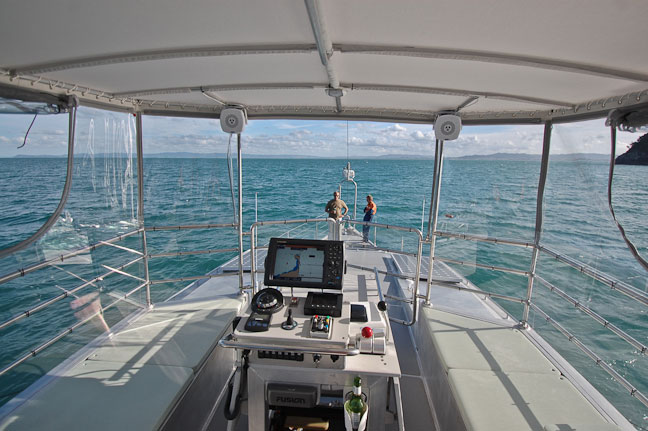
When we were working on the design of Wind Horse Steve Davis suggested a flying bridge enclosure. At the time we could not see the need, thinking we’d simply move to the great room if conditions warranted more protection. Six years and 50,000 miles later we understand the wisdom of his suggestion.
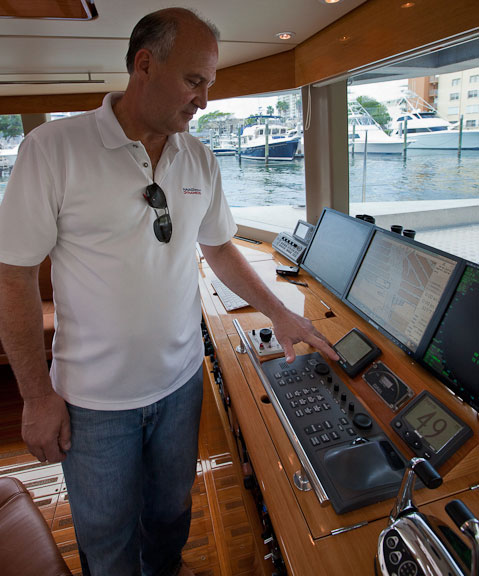
Vic Kuzmovich, NAIAD’s stabilizer guru, was out with us aboard Wind Horse today doing slow speed stabilization tests as a model for the FPB 112. There is a video link at the bottom of this blog so you can see the results for yourself.
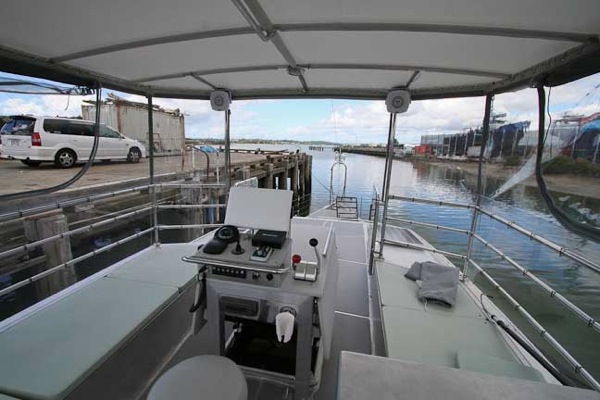
The FPB 64 awning support frame was engineered to simplify the installation of enclosure panels, and the fourth boat, Osprey, is the first to make use of this facility.

Being cold and wet in much of the Northern Hemisphere, with long nights the norm, we thought some light reading material might be in order.
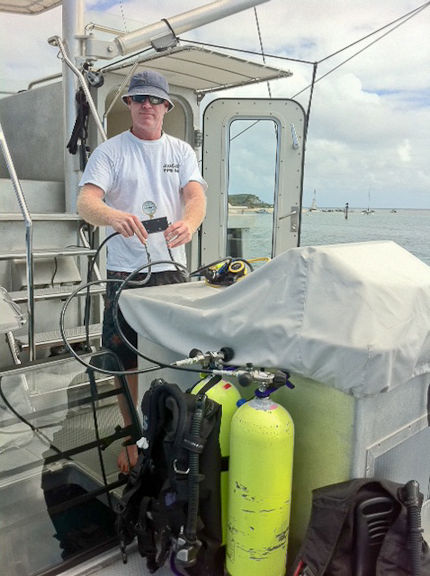
Mike and Carol Parker, the owners of the FPB 64 Avatar, are avid divers. We asked Mike for some details on how they handle getting three sets of dive gear into the dinghy, and Mike was kind enough to take a few photos and send some comments.
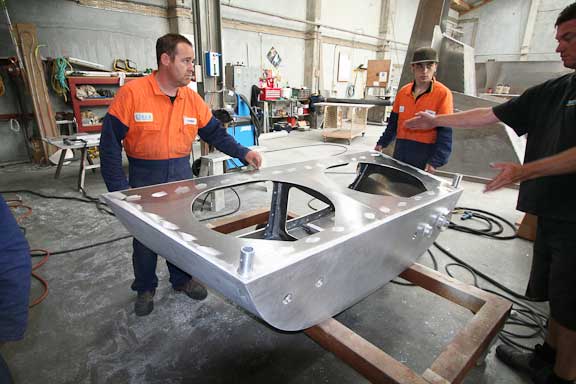
Within the next few days FPB 64 #3 will be ready to start sea trials. As she is being fitted with a swim step extension we are all awaiting the real world results from this small, but potentially potent addition.
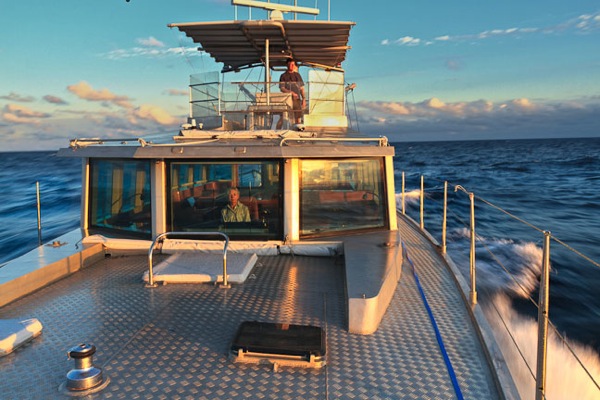
With Wind Horse at rest we have been able to get an accurate measure of the fuel left aboard. To do this we have moved all remaining fuel to the forward central tank, and then measured its height with our calibrated Tank Tender. The fuel data for the passage from Las Palmas in the Canary Islands to Fort Lauderdale looks like this: