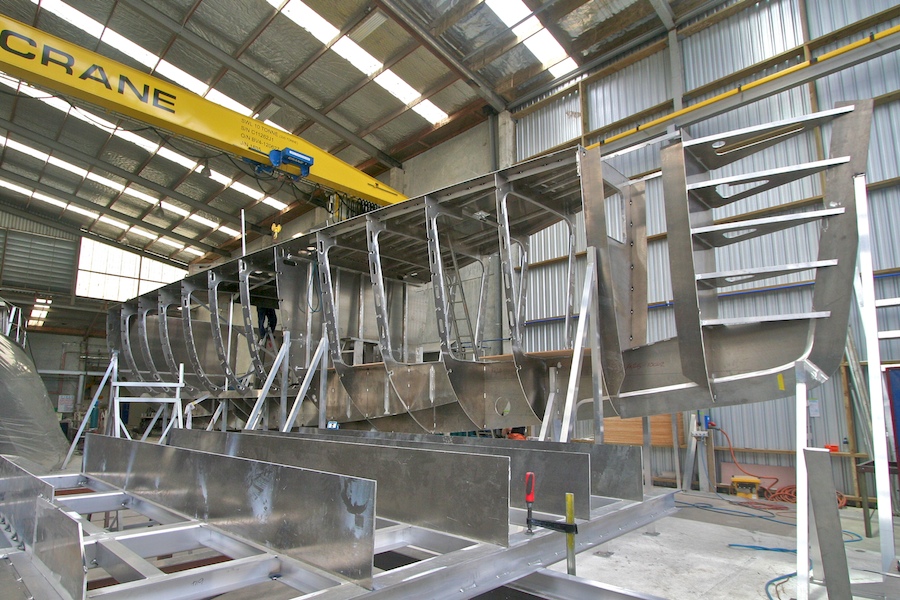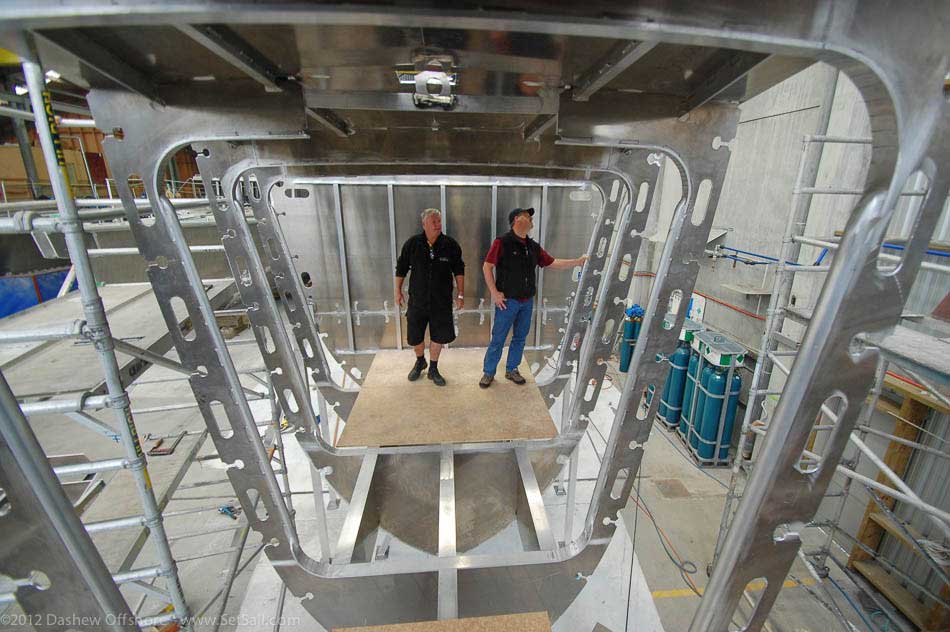
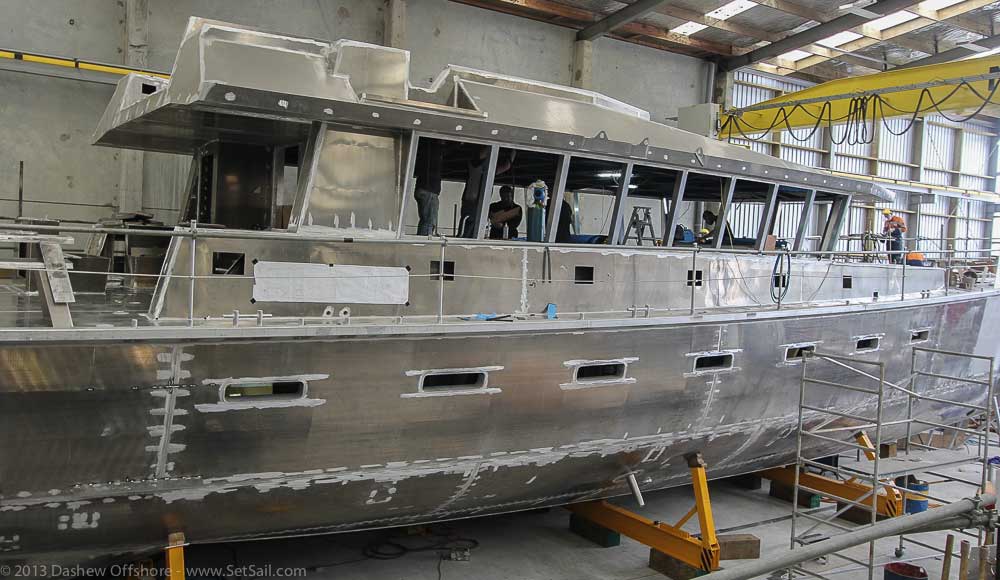
FPB 97-1 is well along now, with the main framing and plating of the hull almost complete.


FPB 97-1 is well along now, with the main framing and plating of the hull almost complete.


Circa is at the stage where visual progress will accelerate, and it will become easier to get a sense of scale for the Wicked FPB 97. Bottom plating is in place and topside plating has begun. Read the rest »
It is that time when the real fun begins, the execution of which separates men from boys, and where the wheeling is now in earnest.

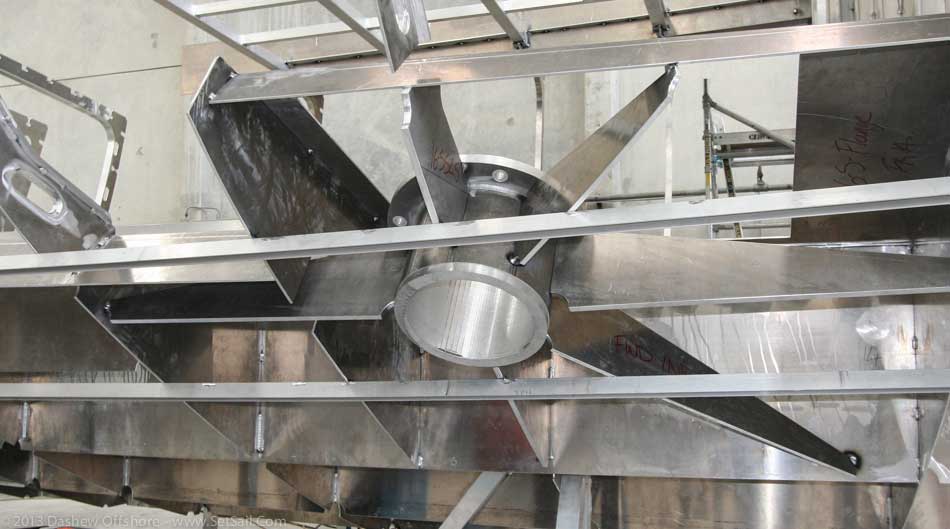
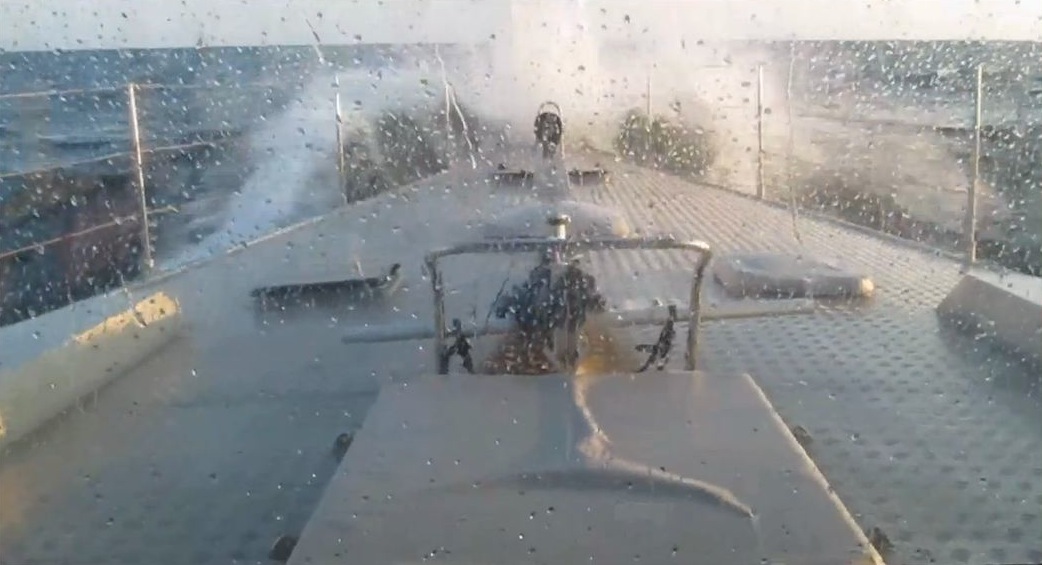
The FPB 97 has enormous stabilizer mechanisms, sized for support when aground and hitting things, the loads for which are far more than hydrostatic loads. The over strength mechanism, however, is of no value, and in fact can damage the boat, if it is not properly reinforced. Read the rest »

We have learned over the years how to rub the world the wrong way and get away with it. This manifests itself in many ways. In the case of the Wicked FPB 97

Even after all the hours spent working with the Wicked FPB 97 to date, we were not prepared for the scale impact when viewing 97-1 in person. Helping us adjust to this new sense Read the rest »
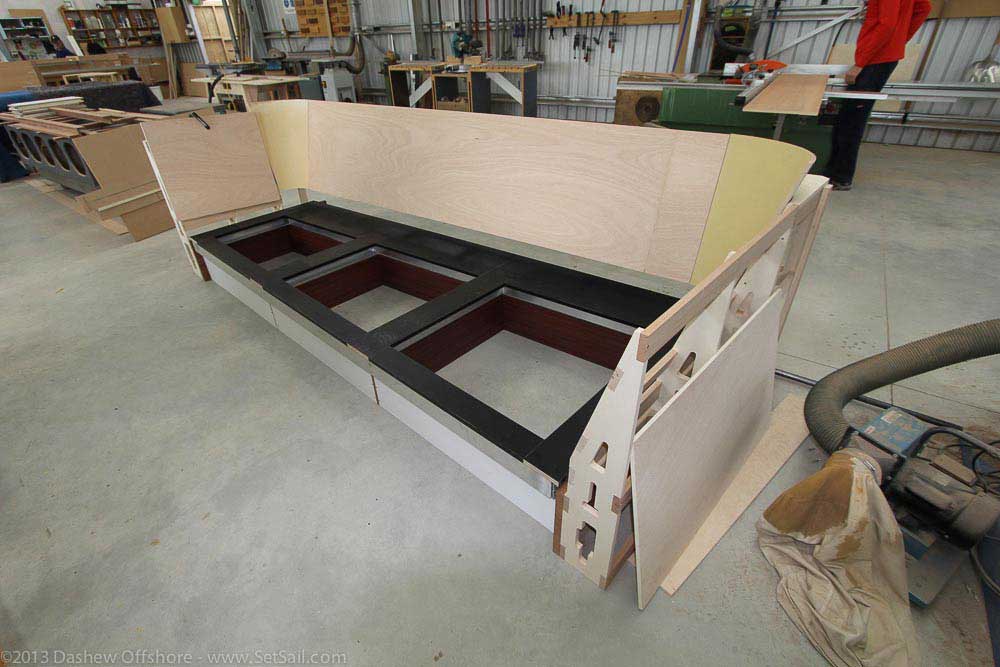
One takeaway from this latest trip to New Zealand was the overall pace and quality of progress that Circa Marine is managing with the FPB 97 program. Read the rest »

Todd and Mark are visiting FPB 97-1 in New Zealand this week and are sending back some great photos Read the rest »
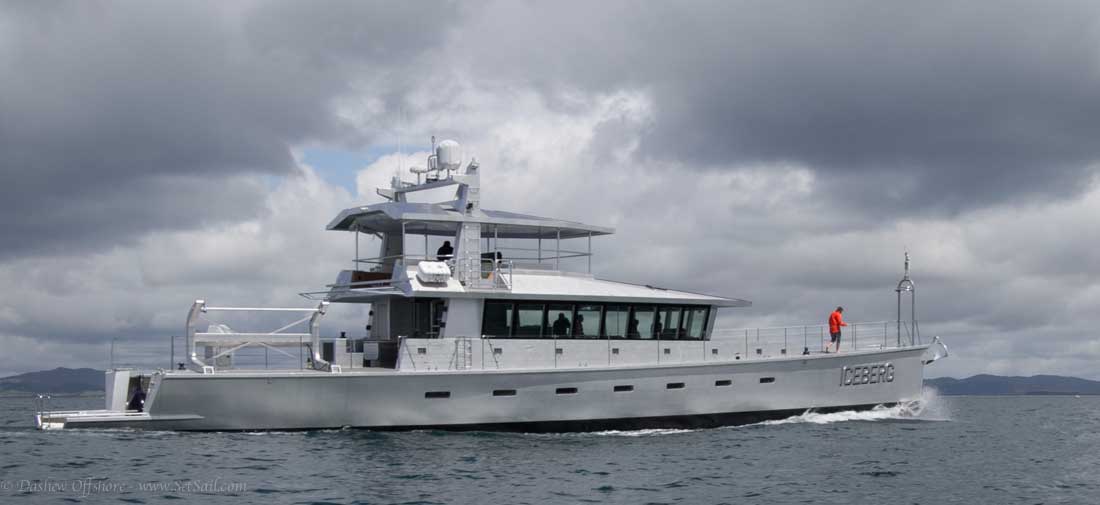
Able to withstand extreme conditions, with self-righting capability, it has the toughest structure ever offered in a series-built yacht.”
-Boat International

Slicing through the barriers of what can and cannot be done with a large yacht, the Wicked FPB 97 redefines the cruising paradigm. Read the rest »

We’ve been at this a long time, seen more yachts under construction than we can remember.. Read the rest »

We’ve been so busy on the details end of FPB 97-1 – a project like this has a tendency to take all your bandwidth – Read the rest »

We thought it was time to devote some computing energy towards showing you the latest on the Wicked FPB 97 Great Room.

You are looking at the business end of what will become an enormously strong bow structure on FPB 97-1. Read the rest »

The Circa team is hard at work on the initial stages of FPB 97-1 fabrication, and we are starting to receive some photos of the process.

A milestone in the FPB 97 program – the first shipment of aluminum plate has arrived from the distributors where it has been in storage.

One of the most difficult design aspects to get right is an underwater exhaust. Powerboat builders and designers have been wrestling with these issues for years, and nobody–let us repeat that, nobody–has a pat answer. With conventional motor yachts, there is so much horsepower involved in propulsion that exhaust noise is a major issue. Add in engine rooms that are almost always near the center of the vessel, and the need for–and difficulty with–an underwater exhaust multiplies.
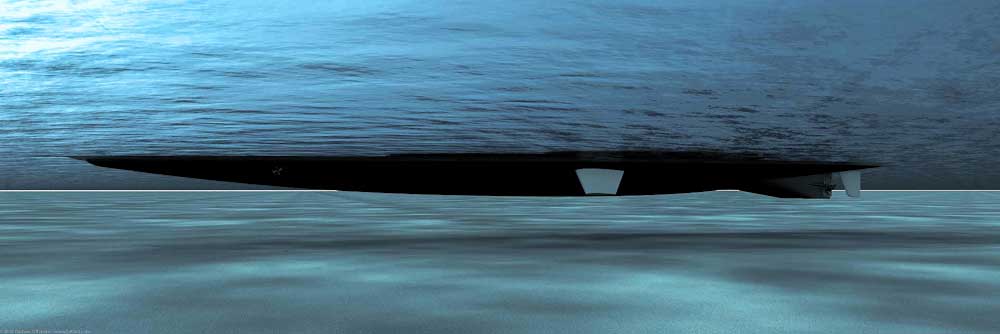
In our case the options are easier. We have very small power requirements, so noise and vibration are minimal. The engine room is all the way aft, so the noise is isolated from the living quarters. The aft location coupled with small engines and big rudders makes it possible to place an underwater exhaust, if indeed it is warranted, behind the prop(s) and rudder(s). This eliminates the inefficiencies that occur when you are injecting exhaust, and the related turbulence, ahead of the propulsion/steering foils.
In the case of the FPB 97, we have a scale model in Wind Horse with which to experiment, which is what we’ve been doing of late. We have set her up with extra payload, so that hull immersion forward and aft is closer to the FPB 97. In the case of the underwater exhausts, this affects the imersion of the exhausts, and how they sound during various sea states.
At the same time, this gives us data on the behavior of the canoe body in unusual (for Wind Horse) load conditions. There are some factors we’ve been studying that point us in a certain direction, and we are testing to see how these work. Changing the trim, moving fuel/water forward or aft to immerse or raise the stern, allows us to get an idea of how the FPB 97 might react.
We are a ways from finalizing things…there are still some configurations to test, but we are zeroing in on a decision.
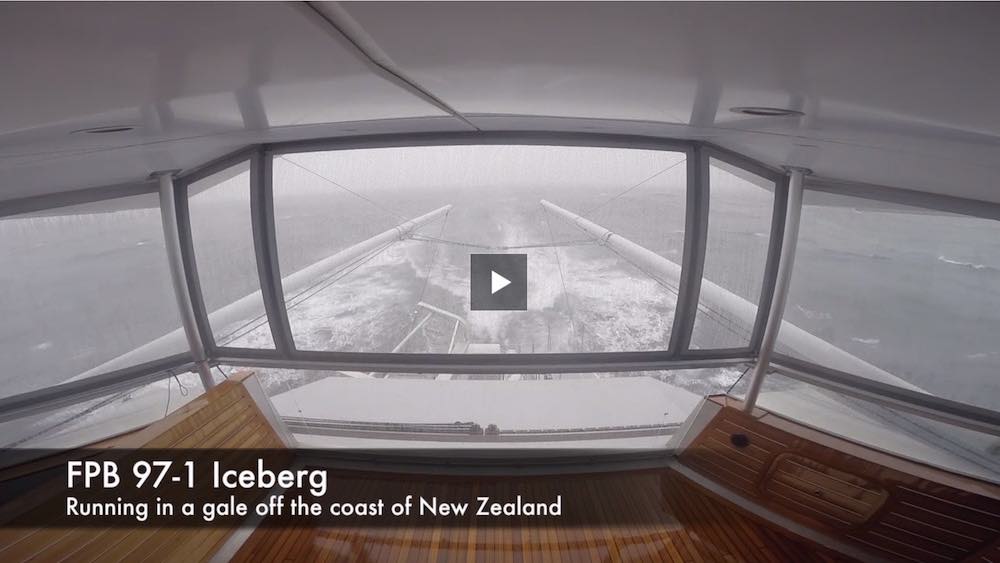
In the meantime, we’ve made a short video, taken going uphill against a 4-to-7 ft (1.2/2.1 m) sea.

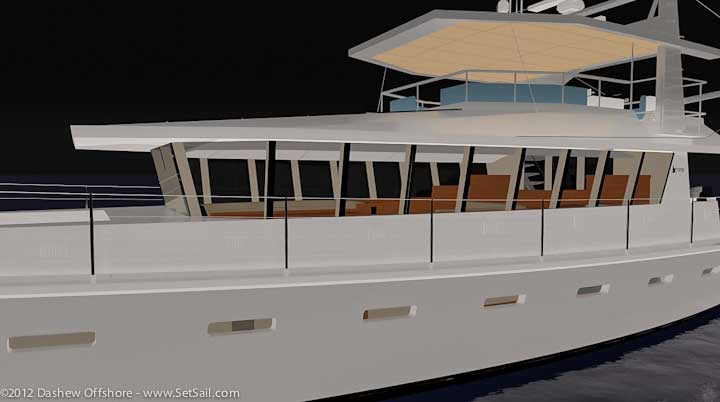
Following is an updated set of exterior renderings for the Wicked FPB 97-1. Additional large sized images of the interior will be added to SetSail.com in coming weeks, so check back from time to time for the latest.
*August 6, 2012: We have just added larger sized images and a more detailed look on a new slideshow. Click here.

We’ve been working through layout options in the great room, fine tuning the original design, and creating something new and exciting for FPB 97-1. There is an interesting contrast between two concepts.

We have an amazing array of rendering tools with which to simulate the real world. This weekend the task at hand (other than keeping an eye on the flora and fauna) is experimenting with night lighting, and it can get confusing at times.

It has been a very long day, with a previously short evening, and after three multi-hour Skype calls to different parts of the world, your correspondent is in need of a pick-me-up. There’s the cold Izze soda awaiting in the corporate lounge, and probably some cheese and crackers. But after a day like this what energizes the soul even more is a bit of Wicked sex.

We’ve been hard at work fine-tuning FPB 97-1 for her very experienced owner. His goal is a highly efficient cruising platform, one which is easy to maintain, and has the highest degree of reliability. There is an instinctive understanding of the difference between the theoretical ideal and the everyday practical. The results so far, of this collaborative effort towards the perfect family cruising yacht, may surprise some observers.

There are numerous structural considerations impacting what can and cannot be done with the exterior shape of a design like the FPB 97. The structural requirements of the window mullions, for example, have an enormous impact on the interior and exterior appearance. So too, the connection of the mullions to the roof structure above and coamings below. The deck framing, sole, and roof support systems are other areas that control aesthetic fate. On the other hand, you cannot start the structural engineering, until you have a pretty good idea of the design. But how do you figure out the design if you don’t know the structural requirements? This is like one of those notes that pops up in a spreadsheet program when you’re building formulae that says “circular reference”.
Our approach to this conundrum is based on the WAG principle.
Read the rest »
One of the more difficult design issues is positioning the stabilizer fins. The considerations are as follows:
Read the rest »
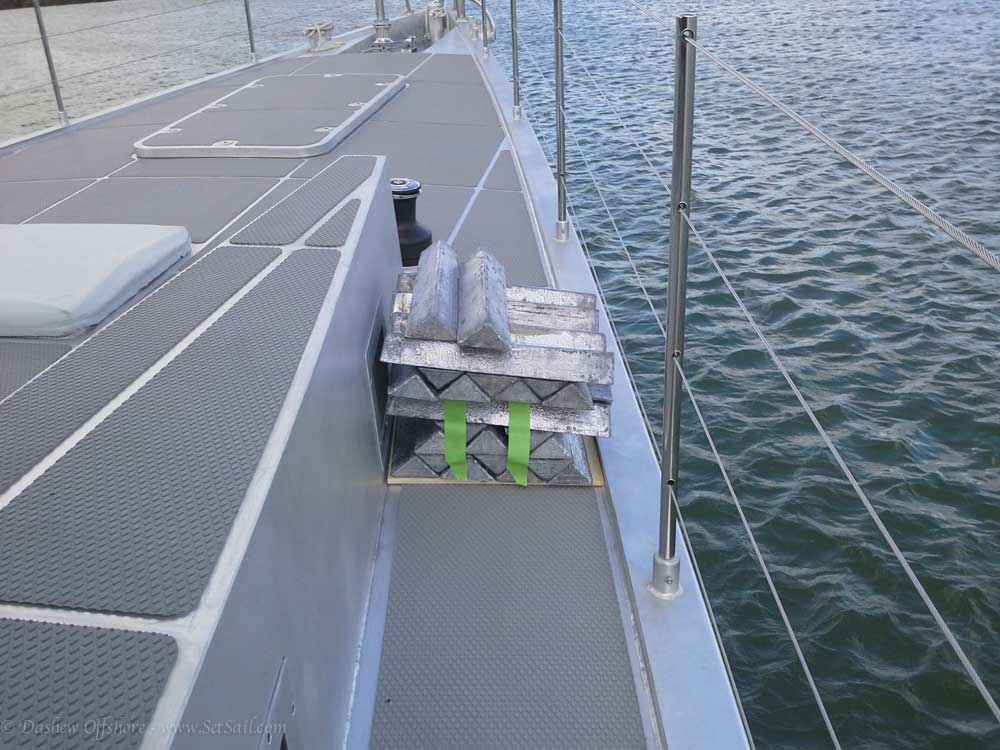
The FPB 97 has a wicked amount of fuel and water capacity, so much so that only in special circumstances would the full amounts of either ever be carried. The weight and position of these liquids obviously have a substantial impact on fore and aft trim and stability. We are dealing with close to 37,000 liters/9,800US gallons of capacity (after deducting for structure, separating coffer dams, and stabilizer coffers).

Big news in the FPB world. FPB 97-1 is underway, and the folks at Circa are hard at work, getting ready for the day when they start to cut metal. On our end, we are ever so pleased to have released hull shape 975-80-C for building. The process that brings us to this point is long, painstaking, and involves a mix of scientific analysis and black art (also known as gut instinct born of experience). As we tend towards obsessive about such topics, perhaps a few comments might be in order.

We are fortunate to have a uniquely talented and capable team involved with us on the FPB 97 project, and want to acknowledge their efforts.
Read the rest »
Now we get to the fun stuff, or as we say on Wind Horse, “the play room.” If you are concerned with safety, ambiance, cost, and frustration, it starts and stops right here. Get the systems and drive line right and your cruising life will be most pleasurable. Get it wrong, well, that is why so many boats sit in marinas and boat yards, and why dreams often turn sour.

A small but important design detail has to do with getting heavy items on/off the boat. This sequence shows a demountable jib crane, comprised of two aluminum pipes. The first series shows use with the forepeak.

Welcome aboard the Wicked FPB 97. Would you like to have a look at the interior? She’s a little different inside than you might be expecting based on what you’ve seen from the dinghy.

The interior decks of the FPB 97 offer many opportunities and a few challenges. There is an enormous amount of volume, which is wonderful to have at anchor, and we want to preserve the sense of openness that comes with that space. But this is a seagoing vessel. There are certain requirements that relate thereto: handholds, furniture that secures one’s body, working areas that are functional in less-than-benign conditions. It is the latter which allows you to enjoyably voyage to those wonderful cruising destinations.

When we first started seriously thinking about going cruising, the accepted wisdom held that a couple could, at best, handle a 38-footer. A unique opportunity came our way to purchase a beautifully maintained and almost new 50-footer, and even though she seemed almost too big, we quickly adapted to Intermezzo’s size, and were happy to have the comfort of a larger yacht. Over the years we went from 50, to 62, to 68, and then 78-footers, all easier to handle for us as a couple than the previous yacht. Wind Horse, at 83 feet, is much easier for the two of us to cruise on than any of our sailing yachts. We think that will be the case with the new FPB 97.
As we have matured (hate that concept!) the idea of taking crew has been discussed more than once. Since this subject is up for its annual review, we thought it might be an interesting exercise to share the crew vs. no crew reasoning. Although we will discuss this in the context of a FPB 97, the logic applies to smaller yachts as well.

Where you intend to cruise, and the ambient weather with which the heating, ventilation, and air conditioning (HVAC) have to deal, is the starting point for the systems analysis and their integration into the rest of the design. The space these take for installation has an impact on structure and interior design, and the power needed to operate them dictates the requirements of both AC and DC electrical systems. Sitting in a lovely anchorage in the Bahamas, or French Polynesia, has totally opposite requirements in this regard versus exploring Tierra del Fuego or visiting Antarctica.

Growing up navigating by sextant and lead line taught us to appreciate modern electronics. We love radar, GPS, SONAR, and AIS. We are attached to free wifi, and data via cell service. What we don’t like is a hodge podge of antennae strewn here and there. So the farm – as in antenna farm – is on the design priority list during the concept phase, to make sure there is an orderly way to install them all.

When it comes to creating a successful yacht for long distance voyaging, you have to start with the fundamentals, and build from there. Get the foundation right, and everything else falls into place. Get it wrong, and regardless of how cool the boat looks, or how much you like the interior, the real world experience is guaranteed to be less than optimal.
We’ve disclosed the exterior of this Wicked new FPB early because it is fundamental to how the boat functions in a holistic systems engineering context. Likewise the Matrix deck, which is also fundamental. Now come the details about what makes possible the cruising dream to which we all aspire.
Read the rest »
“Having a boat that can deal with whatever might happen—no matter what—provides a mental comfort level that defines their view of happy sailing.”
–Bill Parlatore, Editor, Passagemaker Magazine

Designing, specifying, and building a modern cruising yacht demands clear goals about what the yacht is intended to do. In the FPB Series, as with all our yachts, the first priority is going places (read: crossing oceans) in maximum comfort and safety, quickly, with the ability to operate for long periods away from civilization. Toss in optimization for short-handed passage-making–cruising as a couple should the owners so desire–and you have the ability to go where and when you want, without concern for crew requirements, servicing errant systems, or the schedules of yacht transport companies.
“The 83ft-long (25m) wave-piercer…could easily be mistaken for the spawn of the Royal Navy with its unpainted battleship grey, all-aluminum body. But that day, in those conditions, it was the only boat that I would have wanted to climb aboard to face the English Channel.”
–Motor Boat & Yachting

The sun has set, the chimes have struck, we dally no longer. The FPB 97, the Wicked One, stands revealed.

Fanning Atoll is one of those magical places rarely visited by cruising yachts. The lagoon is beautiful, the islanders friendly, and if you happen to be transiting the Pacific to the north during hurricane season, it is the perfect place to wait until you have a clear run up to Hawaii.

In celebration of a final layout for the deck yet to be named, we offer the rendering above with a challenge.

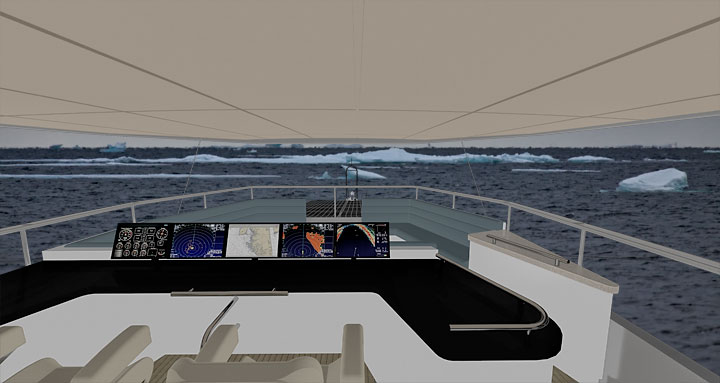
A primary design consideration is always what you can see from various places on board. As yachts get larger the sight lines diminish, and you begin to rely on secondary input: usually crew members wearing headsets, calling distance off the dock or to another vessel, to the con. We’d rather see and judge for ourselves. Hence a rigorous study early, the results of which guide the ensuing design.
There are several different criteria we are looking to fulfill:

Our approach to cruising yacht design is based on the concept that getting there should be as enjoyable as sitting at anchor absorbing a wonderful sunset. If you are physically and mentally comfortable, and instinctively know your vessel can deal with the sea and the odd bit of operator error, then you are going to go places, at the drop of a hat.

Among the very first things we look at in designing a yacht is dinghy storage, launching, and retrieval. This design aspect is as fundamental to successful cruising as anything else aboard. We have had a simple and reliable system since the first FPB first launched seven years ago, modified only recently by the advent of deck winches that power out as well as in. With booms easily controlled by permanent guys, locked off with rope clutches if required, and the dink stowed at deck level, the process is easy enough to get into and out of the water that we usually stow it aboard each evening.
As simple as this is, we still consider this to be potentially the most dangerous job on board.
With the Wicked FPB we have refined the dinghy process to make it significantly easier and more controlled.

We used to envy the folks who cruised with shallow draft for the benefits it conferred. There is the obvious, extending your cruising opportunities to areas like the Bahamas (above), but there other significant advantages as well.

We have a problem gentle reader, and we need your help. The marvelous space we so prosaically call “Pilot Deck” is worthy of a descriptor more in keeping with the view of the world from this unique space.

The new Wicked FPB sports some hot angles, not the least of which is the glazing system surrounding the great room. There are numerous advantages to these outwardly angled windows.

Throughout history, the most successful seagoing vessels have shared common attributes. Take, for example, the greatest warriors and travelers of their time, the fiercesome Vikings. When they sallied forth from their northland fjords, they employed high speed, extremely maneuverable, shallow draft designs to help them expand and conquer their world.

If you are a regular visitor to SetSail.com, you know we like fine rear ends. Flat buttock lines in particular arouse our instincts. With most yacht designs, there is a conflict here between comfort and performance (and this varies with different speeds, or more correctly speed-length ratios). Typically, you pick a speed regime and sea state and live with the results.
But if you stretch the waterline, keeping other design aspects constant, good things begin to happen.

We took the afternoon off, went for a drive, had a gelato, and enjoyed being outside in the harsh winter for which Arizona is known. We’re down to rechecking basic assumptions (again), finalizing deck geometry, and fine tuning the hull shape. This can be a dangerous time in the design cycle.

We are somewhat surprised by the amount of comment induced by the post on the solar array, so we thought we’d update you to the present (things are moving quickly).

When you start to consider powerboat (stinkpot) systems, virtually every decision revolves around air conditioning. Air conditioning holds you hostage. High heat loads from large windows and poor-to-nonexistent shading, coupled with a lack of ventilation, force you to fit large compressors, which means a big genset. Since you cannot do without the genset, you need a second, both of which are too big to just run air conditioning at night, so a small night generator is needed. All other systems decisions flow from this conundrum.
But what if you had good ventilation, even when there was no breeze, and then coupled this with minimized heat loads?

Most of the folks we know in the marine “business” (an oxymoron for sure) play the game for love, or because they simply have no choice, they are pulled to it. The hours are long, the outcome often uncertain, and the risks higher than many economic endeavors.

For years we’ve been wrestling with a way to improve on the FPB 83, Wind Horse. We’ve done smaller, as in the FPB 64: a very efficient, attractively priced, well-mannered yacht. And we’ve worked up a larger version in the guise of the FPB 115, about which we can get excited. But to improve on the Wind Horse combination of comfort, sea-kindliness, heavy weather ability, trans-ocean average speed, systems efficiency, and ease of handling for a couple has yet to happen.

It starts as a hazy vision one sleepless night, an outline, and there is a compulsion to see where it leads, even if it is not on the master plan. When the beast strikes, you have to feed it – there is no other option. Days are long, nights are short, computers whirr overtime and the design spiral fits seamlessly together. Gigabytes criss-cross the internet. Hydrostatics, structure, layout, motion, systems, ventilation, aesthetics – meld wickedly, as if this were meant to be.

When the pieces suddenly fell into place for the FPB 97, a key element of the concept was this new deck. Read the rest »